Category: Injury Prevention
Injury prevention article summaries: April-June 2015
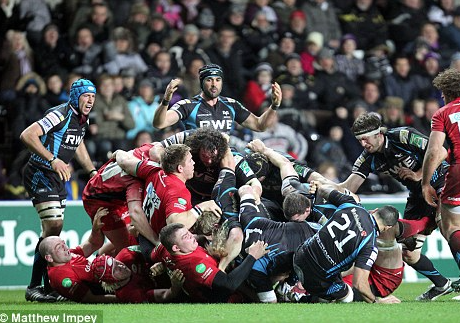
Picture sourced from: http://i.dailymail.co.uk/i/pix/2011/12/20/article-2076823-0F33D39600000578-104_468x327.jpg
This week, we present a summary of some topical papers from the months of April-June in the area of injury prevention in rugby. See the link and full references to the articles at the end of the summary. Please note that the summaries are simply our interpretation of the most salient points and are not supposed to replace you reading the article for yourself.
Collapsed scrums and collision tackles: what is the injury risk? (Roberts et al. 2014):
“Taking into account the number of all events (rucks, scrums, tackles) the tackle has greatest propensity for injury and collision (illegal) tackles are the most risky. Only 5% of scrums collapse, but these have 4 times the injury risk of non-collapsed scrums. Injury prevention should focus on tackle technique and enforcing laws that reduce collapsed scrums.”
Does a standardised exercise protocol incorporating a cognitive task provoke postconcussion-like symptoms in healthy individuals? (Lee et al. 2015):
SCAT2 measured 1 and 15 minutes after exercise cessation for 3 conditions: 1. Exercise vs 2. Exercise + addition (arithmetic) task vs 3. Exercise + Tetris (interactive video game). There was a significant increase in SCAT-measured symptoms score over time for all three conditions. Adding in cognitive-burdens such as arithmetic or video game (Tetris) to the exercise had no additional effect on SCAT-measured symptoms).
When just doing it is not enough – assessing the fidelity of player performance of an injury prevention exercise program. (Fortington et al. 2015)
Only 67% of players were performing the FootyFirst exercises as they were prescribed. This is a problem as correct technique is necessary to elicit the benefits. Footyfirst is a coach-led, exercise-based, lower-limb injury prevention program.
Effectiveness of a tailored neck training program on neck strength, movement, and fatigue in under-19 male rugby players: a randomized controlled pilot study. (Barrett et al. 2015):
Forwards and backs randomised into a neck training (personalised 6-week neck exercise regime based on baseline measurements) or a control group (normal training). No clinically significant findings, although there were trends to improve neck strength, range of movement and susceptibility of neck muscles to fatigue.
Chronic traumatic encephalopathy: a potential late and under recognized consequence of rugby union? (Stewart et al. 2015):
CTE may be under-recognised in rugby. A case is presented to illustrate that a detailed and imaging are critical in assessing patients with neurocognitive disease to prevent misdiagnosis.
Defining a safe player run-off zone around rugby union playing areas. (Fuller et al. 2015) :
Based on video analysis of injurious events occurring outside field of play a minimum distance of 5m around a standard rugby pitch is proposed.
Feel free to let us know your thoughts on these papers!
References:
Barrett M, McLoughlin T, Gallagher K, Gatherer D, Parratt M, Perera J, et al. Effectiveness of a tailored neck training program on neck strength, movement, and fatigue in under-19 male rugby players: a randomized controlled pilot study. OAJSM. 2015 May;:137.
Fortington LV, Donaldson A, Lathlean T, Young WB, Gabbe BJ, Lloyd D, et al. When “just doing it” is not enough: assessing the fidelity of player performance of an injury prevention exercise program. J Sci Med Sport. 2015 May;18(3):272–7.
Fuller CW, Jones R, Fuller AD. Defining a safe player run-off zone around rugby union playing areas. Inj Prev. 2015 May 25.
Lee H, Sullivan SJ, Schneiders AG. Does a standardised exercise protocol incorporating a cognitive task provoke postconcussion-like symptoms in healthy individuals? J Sci Med Sport. 2015 May;18(3):245–9.
Roberts SP, Trewartha G, England M, Stokes KA. Collapsed scrums and collision tackles: what is the injury risk? Br J Sports Med. 2014 Feb 10.
Stewart W, McNamara PH, Lawlor B, Hutchinson S, Farrell M. Chronic traumatic encephalopathy: a potential late and under recognized consequence of rugby union? QJM. 2015 May 21.
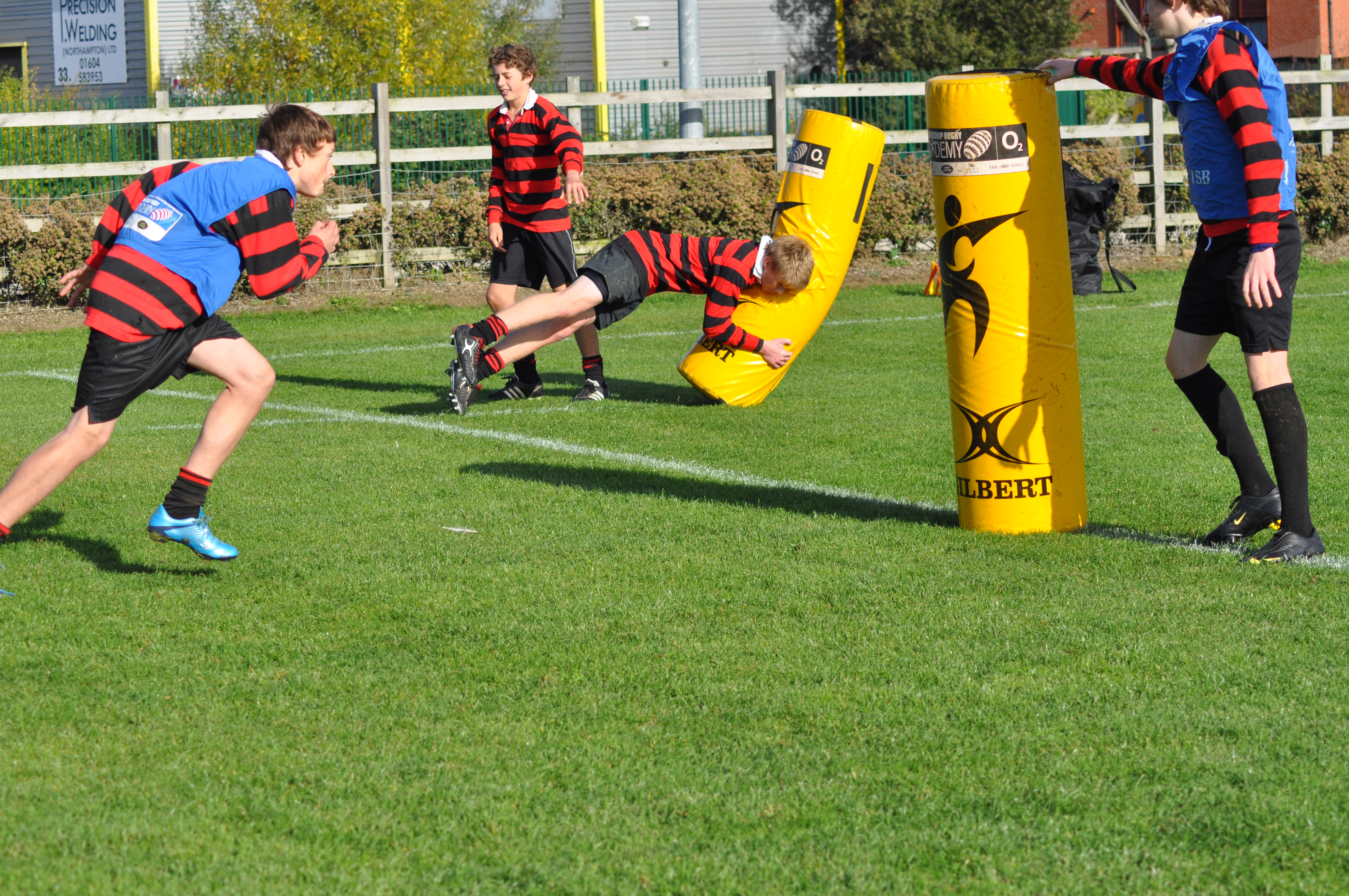
Why are we still using the ‘tackle’ bag to train tackling?
The origin and history of the tackle bag
Mimicking the ball-carrier?
Just posing the question highlights all the limitations of the tackle bag. The main one of course being that the tackle bag does not move compared to the ball-carrier in a match. There are a number of others too, weight, distinction between body parts, counter-drive etc.

Tackling technique
The obvious, major contention with the tackle bag is the technique players are learning and executing while ‘tackling’ the cylindrical shaped foam filled bag. During training session using the tackle bag, players typically dive into contact. Add into the drill a conditioning component (a common practice), players tend to start falling into contact. Technically speaking, this goes against most (if not all) safe and effective techniques prescribed for executing a tackle. I will refrain from going into detail and compare specific techniques required for safe and effective tackling, and the techniques used when using the tackle bag – we try to keep these articles short.
Scientific Research?
Studies specifically comparing techniques executed when using different equipment compared to live tackle training and tackling during matches don’t exist (to my knowledge). With that said, the tackle bag is mentioned in some studies looking at the tackle event. For example, in a paper on attitude and behaviour of junior rugby union players towards tackling during training and match play, the tackle bag was ranked in the top five most frequently used methods for coaching the tackle. One of the lowest ranked methods was ‘‘live tackling in a 1 vs. 1 player grid’. These findings imply that coaches prefer using padded equipment such as the tackle bag or shield rather than live 1 vs. 1 tackling, perhaps in an attempt to safeguard the players from injury in training. While the use of the padded equipment may arguably lower the risk of injury in training compared to live tackling, tackle bags and shields do not mimic real match conditions, and therefore may increase the risk of injury in matches. Other studies used the tackle bag as part of their methods to investigate muscle activity around the shoulder when tackling, and the forces produced when tackling a stationary tackle bag.

Sharief Hendricks
References
Hendricks, S., Matthews, B., & Roode, B. (2014). Tackler characteristics associated with tackle performance in rugby union. European Journal of Sport Science. doi:10.1080/17461391.2014.905982
Usman, J., McIntosh, A. S., & Fréchède, B. (2011). An investigation of shoulder forces in active shoulder tackles in rugby union football. Journal of Science and Medicine in Sport, 1–6. doi:10.1016/j.jsams.2011.05.006
Horsley, I., & Herrington, L. (2006). Electromyographic analysis of the tackle within rugby football. Physical Therapy in Sport. doi:10.1186/1758-2555-1
Hendricks, S., Jordaan, E., & Lambert, M. (2012). Attitude and behaviour of junior rugby union players towards tackling during training and match play. Safety Science, 50(2), 266–284.
Rugby Sports Medicine literature: the week in review
 (http://www.rugbydump.com/2014/12/4005/jean-de-villiers-injury-might-rule-him-out-of-rugby-world-cup-2015)

There were about 25 articles that flashed up on our radar this week as being applicable to Rugby and sport’s medicine. We have subjectively decided to focus on three of these 25 articles that we thought might be of particular interest to our readers (all happen to come from BJSM – this was a fluke…or not!):
- Get Set: prevent sports injuries with exercise! (Verhagen, BJSM):
- Get Set is a free app, developed by IOC, that provides prehabilitative exercises (similar to Safe Six) to prevent injuries for 30 sports (including rugby).
- The exercises are either sport- or region-specific and provide three levels to advance the difficulty of the exercises.
- Limitation: not clear if all exercises are “evidence-based” and there is no feedback/motivation to the user.
- Does long-distance air travel associated with the Sevens World Series increase players’ risk of injury? (Fuller et al. BJSM):
- Followed all players from the nine international teams consistently competing over five years of tournaments.
- There was insufficient evidence to show association with air travel or crossing time zones and injury risk/performance.
- Limitation: the study might be underpowered for examine effect of travel.
- Prevention of groin injuries in sports: a systematic review with meta-analysis of randomised controlled trials (Esteve et al., BJSM)
- Systematic review with meta-analysis of RCTs in football (american) and ice hockey that had groin-specific injury prev programs.
- Found a potentially clinically meaningful, but not statistically significant reduction (19%, on average).
- Limitation: low rate of groin injuries in studies generally, therefore difficult to assess effectiveness
In the interest of not over-burdening our readers, we’re going to leave it there for now, but feel free to let us know if you think we missed something this week!
 Rugby Science