Category: Injury Prevention
Research in Rugby growing exponentially-Rugby Research’s Top 15
Paging through the recently published book “The Science of Rugby” edited by Dr Craig Twist and Dr Paul Worsfold (link), which covers everything from strength and power training and match-day strategies for enhancing physical and technical performance, to nutrition and biomechanics in both rugby union and rugby league, I remembered there was a time not too long ago published research articles in rugby were few. To check that I was not falling victim to the recall bias, and because it is a Rugby World Cup year, I did a little Scopus search to determine the current status of research in rugby. Scopus is like Google, but for research papers. Scopus also organises information by year, source, country and affiliation.
So, the 1st search I did was for articles using the term “Rugby” in the title, abstract or part of the keywords. Using the term “Rugby” like this in Scopus means both League and Union papers will be included. Note, I did not exclude areas like humanities and business, and all data points may not represent full research articles. This is what we found…
Number of articles published on “Rugby”
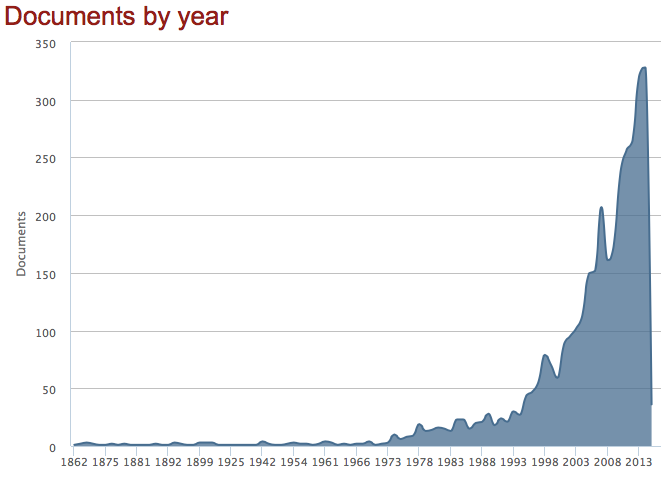
3051 published articles since 1862, 40% of these published in the last 5 years.
Top Journals publishing on “Rugby”
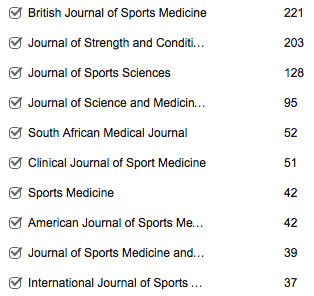
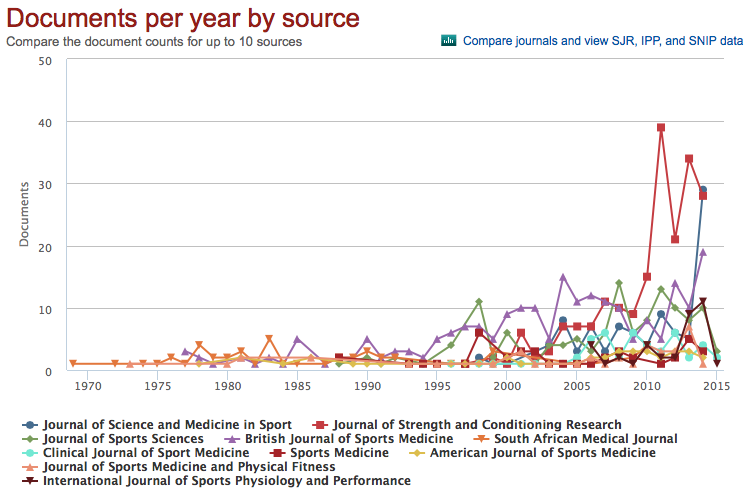
Top journals publishing in rugby are BJSM, JSCS, JSS, and JSMS. SAMJ was the first journal to publish on rugby, BJSM the most consistent, and JSCS the most number of publications in the last 5 years.
Top Authors publishing in “Rugby”
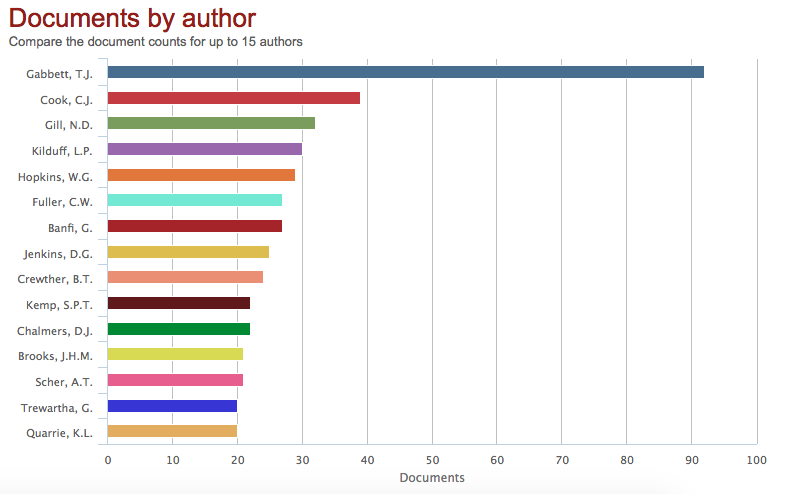
Most published author in rugby- Tim Gabbett (Gabbett Performance)-no surprise there. The head S&C coach of the top performing team in the world, Nicholas Gill, is the 3rd most published author in rugby research. This says something.
Top affiliations publishing in “Rugby”
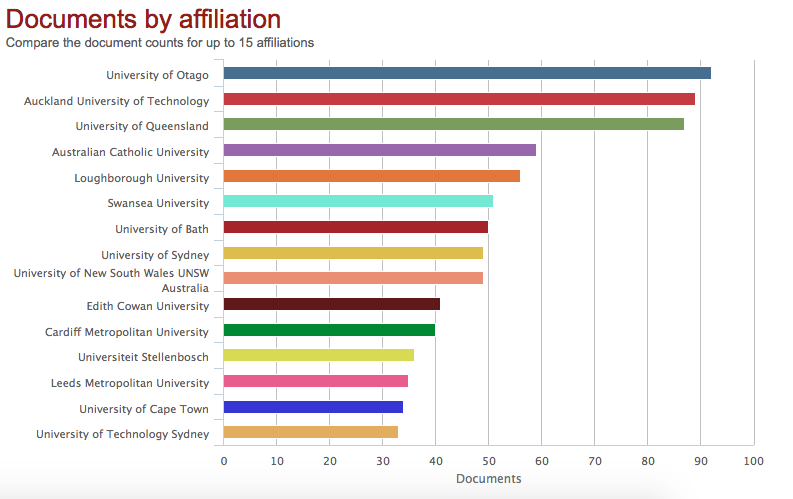
Top countries publishing in “Rugby”
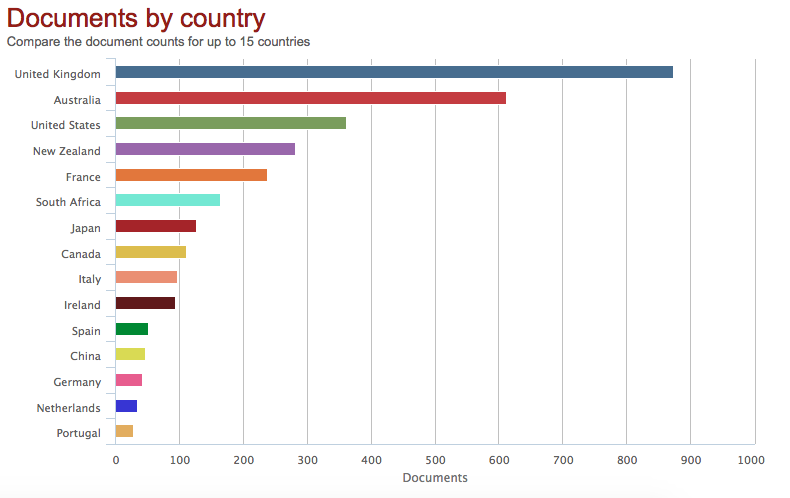
We did the same search for “Rugby Union”. Using this search term will only output papers containing “Rugby Union” in the title, abstract or part of the keywords.
Number of articles published on “Rugby Union”
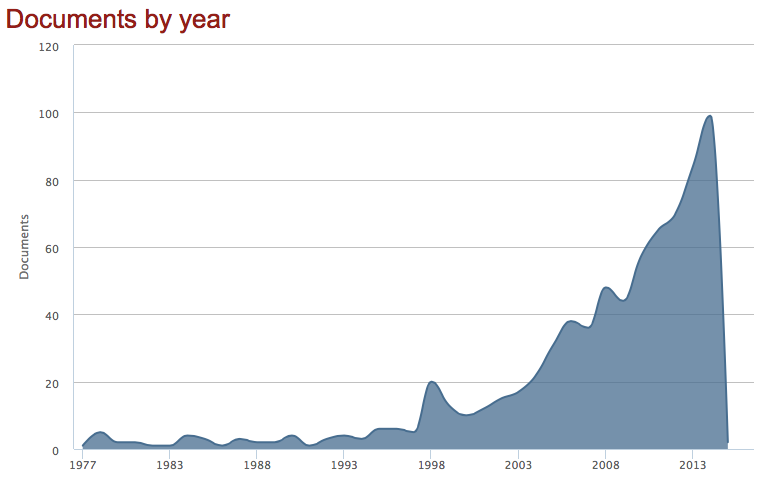
742 articles. Approximately 50% published in the last 5 years.
Top Journals publishing on “Rugby Union”
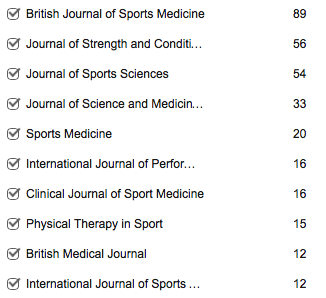
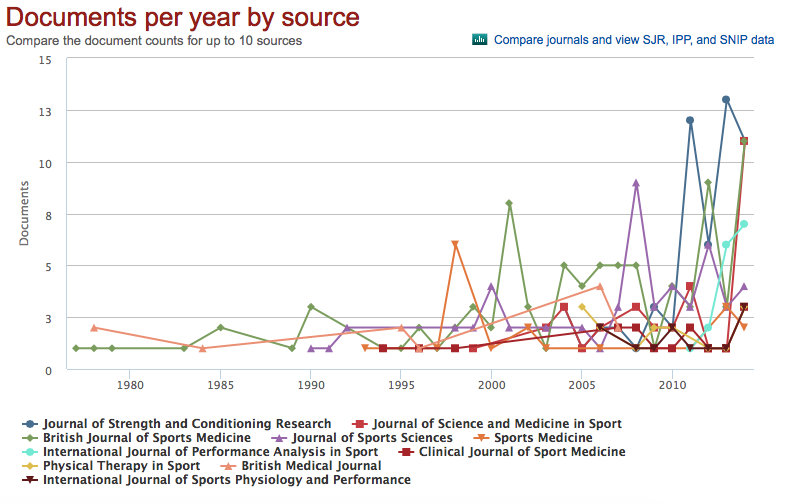
Top Authors publishing in “Rugby Union”
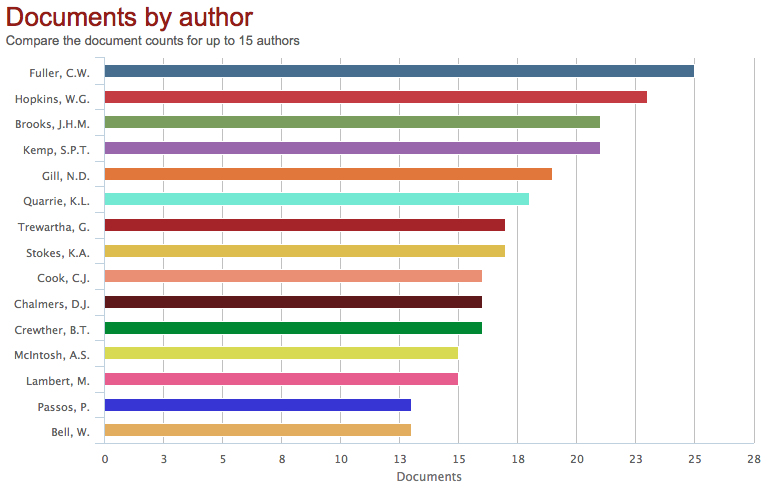
Top affiliations publishing in “Rugby Union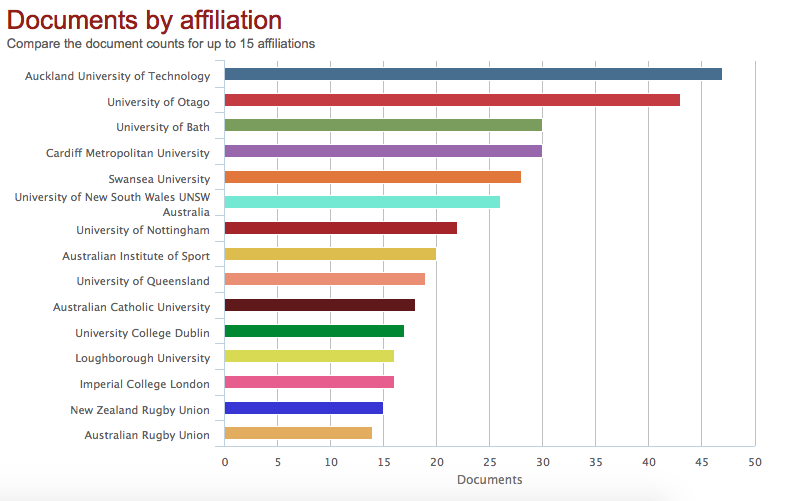 Top countries publishing in “Rugby Union”
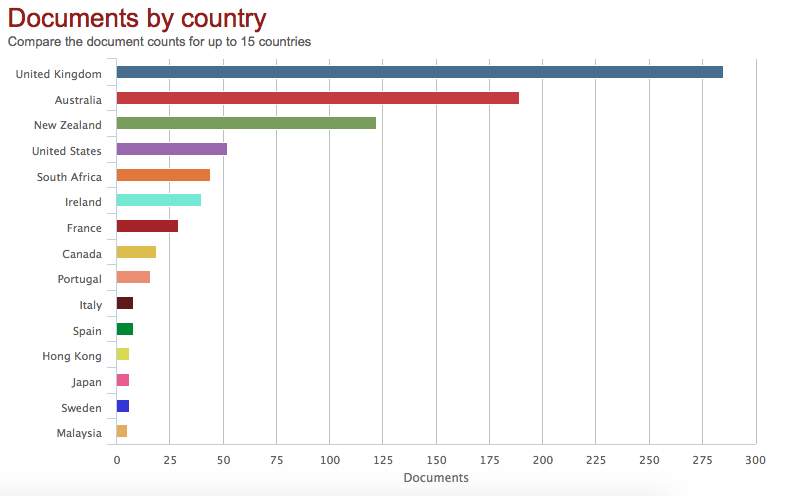
I have a particular interest in the tackle situation. So, I did a search for “Rugby” AND “tackle”. Below are the results…
Number of articles published on “Rugby” AND “tackle”
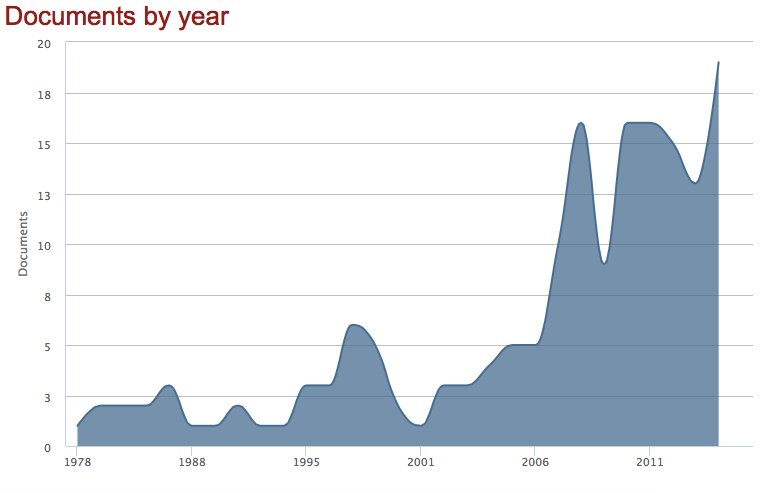 170 articles. Approximately 46% published in the last 5 years.
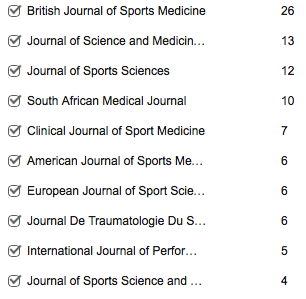
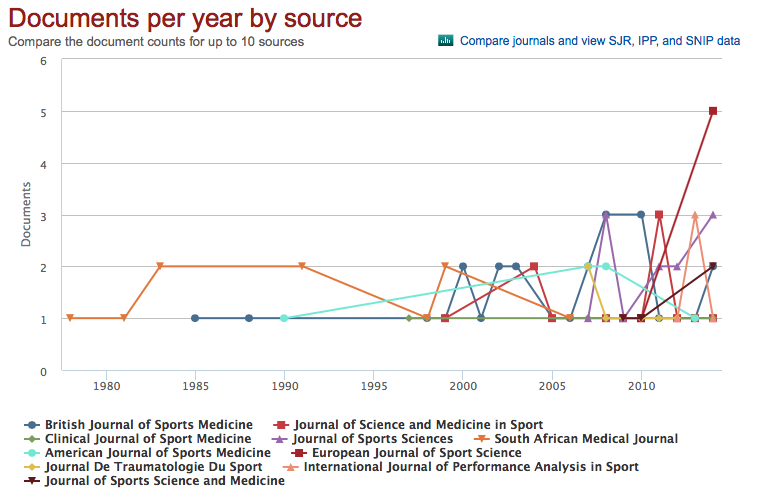
Top Journals publishing on “Rugby” AND “tackle”
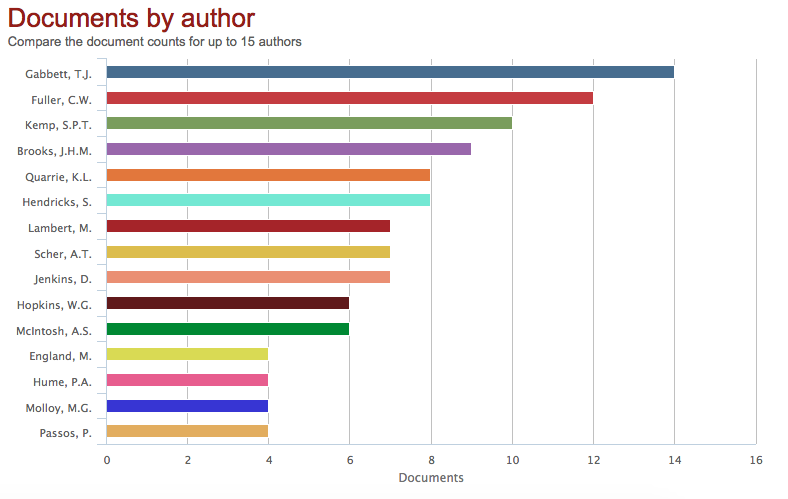
Top authors publishing on “Rugby” AND “tackle”
Top affiliations publishing on “Rugby” AND “tackle”
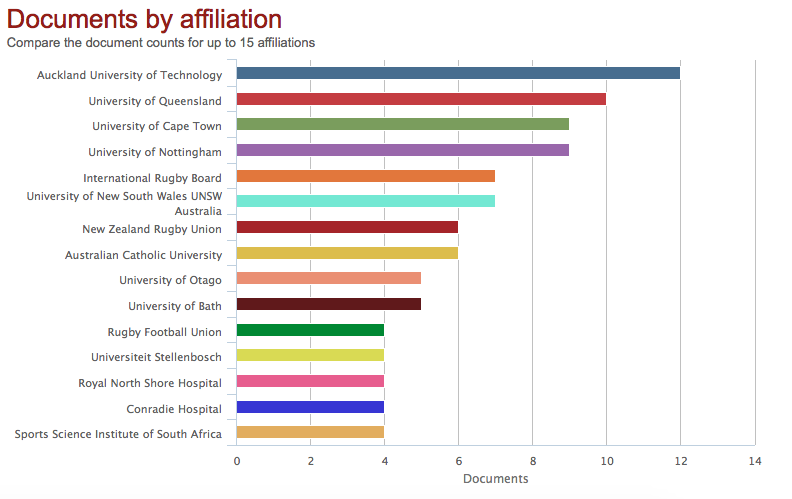
Top countries publishing on “Rugby” AND “tackle”
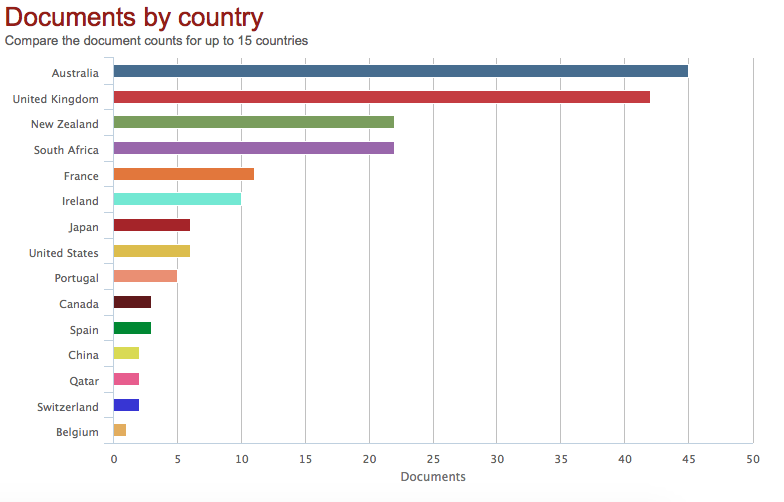
We could do the same searches for any aspect of the sport really (for example, the scrum).
Although research in rugby may be growing at a rapid pace, rugby (league and union combined) is still behind other team sports like football (I did a small search on “football” OR “soccer” and Scopus produced 26941 papers), and there is plenty of scope for research (not too sad about this). There are obvious products from this body of work (better conditioned players, more knowledgeable coaches, reducing the risk of injury, etc), but in terms of conducting research, the exponential increase in rugby research somewhat forces scientists to be creative, and highly applied in their studies.
Sharief Hendricks
Legislation effective for concussion prevention/management
SUMMARY: Legislation/regulation is an effective strategy to prevent and manage neurological injuries (including concussion).

The recent article of Gibson and colleagues 1 in JAMA paediatrics indicates that legislation can be effective in improving concussion management in children. Similarly, Cusimano et al. 2 concluded that there is more evidence to support wide-spread mandatory interventions (form of legislation/regulation) than protective equipment for the prevention of rugby-related neurological symptoms. This success could be related to the fact that some form of behaviour change is required if an intervention is to reduce injuries 3. Also, the advantage of legislation is that its effects are not dependent on a specific coach or player 4.
In combination, these two articles would suggest that nationwide prevention programmes such as RugbySmart or BokSmart are useful interventions for preventing and managing rugby-related neurological injuries.
References:
- Gibson TB, Herring SA, Kutcher JS, Broglio SP. Analyzing the Effect of State Legislation on Health Care Utilization for Children With Concussion. JAMA Pediatr. 2014 Dec 22.
- Cusimano MD, Nassiri F, Chang Y. The Effectiveness of Interventions to Reduce Neurological Injuries in Rugby Union: A Systematic Review. Neurosurgery. 2010 Nov;67(5):1404–18.
- Gielen AC. Application of Behavior-Change Theories and Methods to Injury Prevention. Epidemiol Rev. 2003 Aug 1;25(1):65–76.
- Benson BW, MCINTOSH AS, Maddocks D, Herring SA, Raftery M, Dvorák J. What are the most effective risk-reduction strategies in sport concussion? Br J Sports Med. 2013 Apr;47(5):321–6.
The tragic injury of Jean De Villiers
If you haven’t already seen it, the tragic injury that the Springbok captain suffered on the weekend test match against Wales is shown in this Youtube video by the uploader “World Rugby”:
Almost a year ago today, we wrote a post suggesting that unless his schedule was reduced, Jean De Villiers was at ‘high risk’ of missing the Rugby World Cup 2015 through injury. Despite this recent injury, we would like to hope that our post never actually comes true. Rather than claim ourselves to be Nostradamus of the ‘injuries in Rugby world’, we would like to point out our considered thoughts on our own post after this unfortunate incident:
Our post, and it’s references, mainly refer to the risk of suffering a non-contact type injury: for example, a spontaneous hamstring or groin injury while performing a non-contact activity such as running without the ball. It is far more difficult to predict the type of injury that De Villiers suffered against Wales which was clearly related to the contact his knee incurred. Unfortunately, there is very little scientific evidence for these injuries.
Nonetheless, it is a truism that the more games of rugby you play (= greater ‘exposure’), the greater the chance that you will suffer any type of injury (contact or non-contact). So it seems obvious that De Villiers should have been rested more this year: the year before his final Rugby World Cup. Why didn’t this happen? We suggest two reasons:
1. The Springbok ‘caretakers’, the South African Rugby Union (SARU), do not have autonomous control over De Villiers or any other player’s total match time. Until SARU have the level of centralised control over their players that the New Zealand Rugby Union (NZRU) have, a ‘Richie McCaw’ resting strategy is no more than a braai discussion point. Furthermore, it would be interesting to know the opinion of the most important person in this hypothetical question – De Villiers himself. Would he have wanted to miss any of the games he played this year?
2. Empirical evidence for total match time in contact sport is lacking. As much as it may be ‘common sense’, there is no empirical evidence to show that NZRU’s strategy was effective in reducing injuries to their captain. The only scientific way to establish if NZRU’s strategy was effective would be to have another Richie McCaw who wasn’t rested for the same period and compare which Richie was injured less! This is, of course, impossible. To our knowledge, the only union to have adopted a match limit (of 40 per year) for some of their contracted players is the French Rugby Union. Owing to the aforementioned issues, it would be difficult to establish what the optimal annual match limit should be.
What are your thoughts on the De Villiers injury? Do you feel like it could or should have been prevented? We’re interested to know!
Most importantly though, we are hoping along with the rest of South Africa that Jean De Villiers has as speedy a recovery as is possible following such an unfortunate injury.
 Rugby Science