Category: Strength and Conditioning
Moving beyond the “brainless” model of resistance training
What is the LEAST amount of training we need our athletes to do to get the BEST results out of them?
What is the role of the central nervous system in strength development?
In a series of posts, we will attempt to answer these questions.
In this post, we will cover some basic muscle physiology.
There are 2 principles that govern the ability of an athlete to develop maximal strength…
1) Henman’s Size Principle
The recruitment threshold of each motor unit is governed directly by the size of its axon. Thus, all motor units are recruited in an ascending order according to their relevant size.
Larger motor units having higher recruitment thresholds produce greater amounts of force, whereas smaller motor units have lower recruitment thresholds and produce less force. Due to their smaller threshold potential smaller motor units are recruited first (Baechle & Earle, 2008; Kraemer & Looney, 2012).
It is for this reasons that well- planned sequential (Hypertrophy –> strength –> power –> complex) resistance training phases are implemented, as it is only the activated motor units that undergo anabolism (“building”). Whereas catabolism (“breakdown”) is found to occur in non-activated motor units, due to exposure catabolic substances such as, inflammatory cytokines, free radicals, cortisol, etc. (Kraemer & Looney, 2012).

The Selective Recruitment Principle
The All-OR-NONE law, i.e. number of motor units recruited, as well as the number of motor units in a muscle, plays a role in power production. However, an exception to the rule is that well-trained athletes may be able to inhibit lower threshold units and in their place, activate the higher threshold motor units, thus increasing rate of force development and power output.
Check out the paper in Strength & Conditioning Journal, “Underlying mechanisms and physiology of muscular power” by Kramer et al (2012) for more detail.
Further to the adaptions above, the neuromuscular junction (NMJ) also undergoes the following changes:
- Increase in NMJ area
- Increase in length of nerve terminal branching
- Increased motor end plate perimeter
- Greater dispersion of muscle receptors
In practice, implementing various advanced strength-training methods increase motor unit recruitment. For untrained individuals though, the ability to recruit fast twitch fibers/high threshold motor units may be limited. Motor unit recruitment for untrained individuals is sparked by the motor cortex activity and through neural efficiency.
Your thoughts?
Regards,
Wayne
Small sided games – experts vs. novices (by Prof. Luis Vaz)
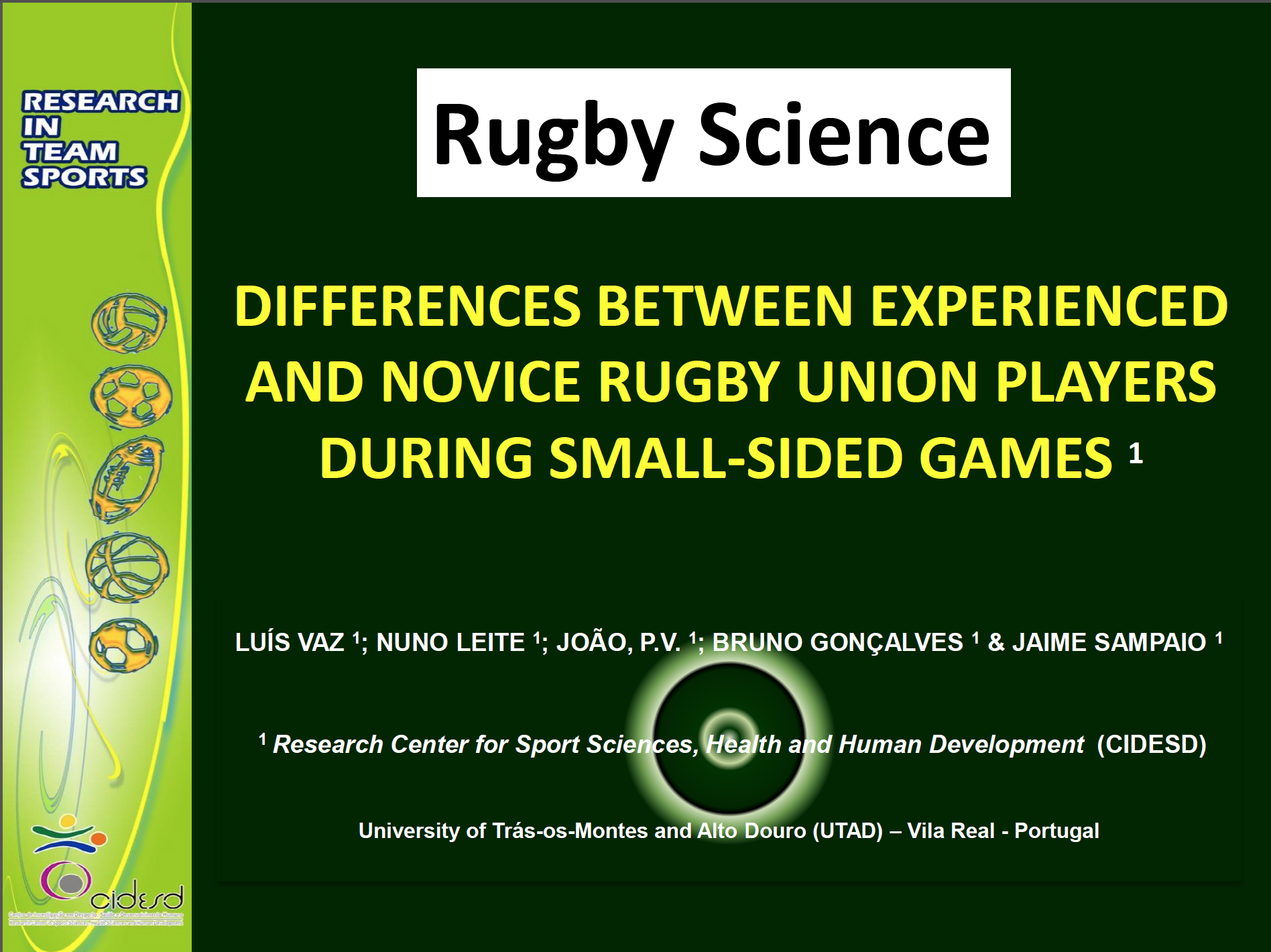
This week, we have pleasure in publishing the presentation of Professor Luis Vaz on small-sided games (SSGs) in Rugby Union. For the full presentation (courtesy of Prof. Vaz) click this link: Luis Vaz et al Rugbyscientist Presentation
Professor Vaz is a Professor of Sport and Exercise Science at the University of Trás-os-Montes and Alto Douro (UTAD), a researcher in Center in Sport Sciences, Health and Human Development (CIDESD) and a Rugby Performance Analyst for Portugal Rugby Federation (F.P.R.). You can email him on: lvaz@utad.pt
Why are we still using the ‘tackle’ bag to train tackling?
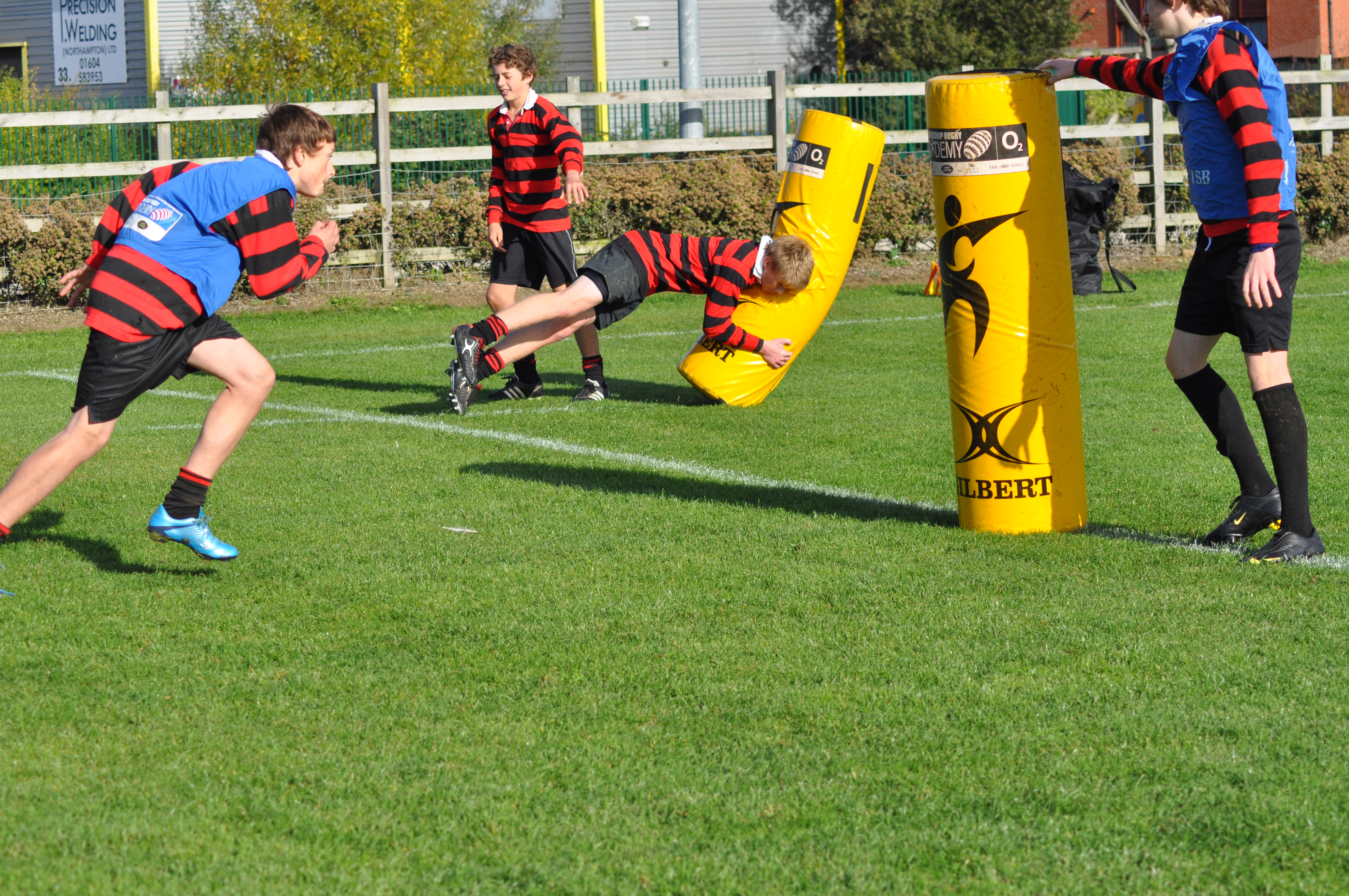
The origin and history of the tackle bag
Mimicking the ball-carrier?
Just posing the question highlights all the limitations of the tackle bag. The main one of course being that the tackle bag does not move compared to the ball-carrier in a match. There are a number of others too, weight, distinction between body parts, counter-drive etc.

Tackling technique
The obvious, major contention with the tackle bag is the technique players are learning and executing while ‘tackling’ the cylindrical shaped foam filled bag. During training session using the tackle bag, players typically dive into contact. Add into the drill a conditioning component (a common practice), players tend to start falling into contact. Technically speaking, this goes against most (if not all) safe and effective techniques prescribed for executing a tackle. I will refrain from going into detail and compare specific techniques required for safe and effective tackling, and the techniques used when using the tackle bag – we try to keep these articles short.
Scientific Research?
Studies specifically comparing techniques executed when using different equipment compared to live tackle training and tackling during matches don’t exist (to my knowledge). With that said, the tackle bag is mentioned in some studies looking at the tackle event. For example, in a paper on attitude and behaviour of junior rugby union players towards tackling during training and match play, the tackle bag was ranked in the top five most frequently used methods for coaching the tackle. One of the lowest ranked methods was ‘‘live tackling in a 1 vs. 1 player grid’. These findings imply that coaches prefer using padded equipment such as the tackle bag or shield rather than live 1 vs. 1 tackling, perhaps in an attempt to safeguard the players from injury in training. While the use of the padded equipment may arguably lower the risk of injury in training compared to live tackling, tackle bags and shields do not mimic real match conditions, and therefore may increase the risk of injury in matches. Other studies used the tackle bag as part of their methods to investigate muscle activity around the shoulder when tackling, and the forces produced when tackling a stationary tackle bag.

Sharief Hendricks
References
Hendricks, S., Matthews, B., & Roode, B. (2014). Tackler characteristics associated with tackle performance in rugby union. European Journal of Sport Science. doi:10.1080/17461391.2014.905982
Usman, J., McIntosh, A. S., & Fréchède, B. (2011). An investigation of shoulder forces in active shoulder tackles in rugby union football. Journal of Science and Medicine in Sport, 1–6. doi:10.1016/j.jsams.2011.05.006
Horsley, I., & Herrington, L. (2006). Electromyographic analysis of the tackle within rugby football. Physical Therapy in Sport. doi:10.1186/1758-2555-1
Hendricks, S., Jordaan, E., & Lambert, M. (2012). Attitude and behaviour of junior rugby union players towards tackling during training and match play. Safety Science, 50(2), 266–284.
 Rugby Science