Category: Strength and Conditioning
FIFA 11+: An effective way to reduce injuries in amateur soccer players?
by Aminah Emeran
Soccer is arguably the most popular sport globally, with an estimated 200 million players worldwide (1). There are many health benefits of playing soccer, including reducing the risk of type 2 diabetes and hypertension (2). Despite its health benefits, soccer also poses a significant risk of injury (3), particularly to areas such as the knee, ankle and thigh (4). These injuries are largely attributed to insufficient warm-ups, muscle fatigue and imbalance (5). A study conducted on the incidence of soccer injuries, showed that 15-20 injuries occurred per 1000 hours of match play, in players above 15 years old (6).
Because of the high incidence of soccer injuries worldwide, an injury prevention strategy for amateur players was developed in 2006, called the FIFA 11+. The FIFA 11+ comprises of a simple warm-up routine consisting of 15 exercises, that soccer players are to perform for a minimum of 2 times per week. The warmup requires minimal equipment, is available online and can be performed within 10-15 minutes (7).

The FIFA 11+ prevention programme
Does the warmup reduce injury risk?
This question was answered by conducting trials that implemented the FIFA 11+ intervention into real life practice. These trials were then analysed in systematic reviews. The studies selected for review were implemented in a range of locations including North America, Europe, Asia and Africa, and tested male and female amateur players, with ages ranging from 15-45 years (7–10).
Overall results showed that implementing the FIFA 11+ warm-up for about 2 months, reduced the number of injuries in male and female amateur players between 13 and 25 years, by 30-39%. Studies also showed an improvement in motor and neuromuscular performance such as improved balance, increased quadriceps and muscle strength, speed and agility (7,8,10). The largest reduction in injury risk occurred when players adhered to performing the warm-up correctly. This was achieved with the help of supervision from coaches. Studies where little reduction in injury was seen, could be due to lack of compliance to the intervention and lack of guidance from coaches (7).
These results sound very promising. However, there are some limitations in the studies analysed. These include a risk of outcome bias that could result from the participants knowing that they were receiving the 11+ intervention, and the researcher knowing what group did and did not perform the intervention (9). Some studies also used different injury definitions, with some not even defining the type of injury analysed (8).
Despite these limitations, the warm-up has been successfully utilised in other sporting fields, such as basketball. It has also been endorsed by 20 FIFA Member Associations. Thus, given the high prevalence of soccer injuries sustained by amateur players, the FIFA 11+ intervention is recommended to reduce injury risk (7)(9).
References:
- FIFA C. FIFA Big Count 2006: 270 million people active in football. FIFA Commun Div Inf Serv. 2007;31:1–12.
- Krustrup P, Bangsbo J. Recreational football is effective in the treatment of non-communicable diseases. Br J Sports Med. 2015;49(22):1426–7.
- Rahnama N, Reilly T. Injury risk associated with playing actions during competitive soccer. Br J Sport Med [Internet]. 2002;36:354–9. Available from: http://bjsm.bmj.com/
- Price RJ, Hawkins RD, Hulse MA, Hodson A. The Football Association medical research programme: An audit of injuries in academy youth football. Br J Sports Med. 2004;38(4):466–71.
- Ekstrand J, Hägglund M, Waldén M. Injury incidence and injury patterns in professional football: The UEFA injury study. Br J Sports Med. 2011;45(7):553–8.
- Faude O, Rößler R, Junge A. Football injuries in children and adolescent players: Are there clues for prevention? Sport Med. 2013;43(9):819–37.
- Barengo NC, Meneses-Echávez F, Ramírez-Vélez R, Cohen DD, Tovar G, Correa Bautista JE, et al. The Impact of the FIFA 11+ Training Program on Injury Prevention in Football Players: A Systematic Review. Int J Environ Res Public Heal [Internet]. 2014;11:11. Available from: http://www.mdpi.com/journal/ijerph
- Thorborg K, Krommes KK, Esteve E, Clausen MB, Bartels EM, Rathleff MS. Effect of specific exercise-based football injury prevention programmes on the overall injury rate in football: A systematic review and meta-analysis of the FIFA 11 and 11+ programmes. Br J Sports Med. 2017;51(7):562–71.
- Sadigursky D, Braid JA, De Lira DNL, Machado BAB, Carneiro RJF, Colavolpe PO. The FIFA 11+ injury prevention program for soccer players: A systematic review. BMC Sports Sci Med Rehabil. 2017;9(1):1–8.
- Bizzini M, Dvorak J. FIFA 11+: An effective programme to prevent football injuries in various player groups worldwide – A narrative review. Br J Sports Med. 2015;49(9):577–9.
Wimbledon – it’s not all just strawberries and cream
by Jenna Bloom
When you’re watching Wimbledon, have you ever wondered how busy the doctors and physiotherapists are behind the scenes?
Well, McCirde et. al. (2016) wanted to determine the rate of injuries that occurred during Wimbledon, which could assist scientists to eventually develop measures to prevent injuries. (3)
They study found that there were 700 injuries over the 10 years of Wimbledon (2003 to 2012), with a total of 12 212 sets played. The overall injury rate was 20.7 injuries per 1000 sets played. (3) McCirde et. al. (2016) observed that males had lower injury rates than females despite males playing more sets. (3) However, Sallis et. al. (2001) found that there was no significant difference in injury rate between females and males across seven different sports including tennis. (6) Differences in injury rates between sexes could be due to woman having higher oestrogen levels, more fat, more flexibility and less muscle mass. (5)
Figure 1 indicates the percentage of each injury type sustained over the 10 years of Wimbledon. This figure shows that there was a large percentage of injuries sustained before Wimbledon, indicating the demanding nature of a professional tennis players’ season. (3)

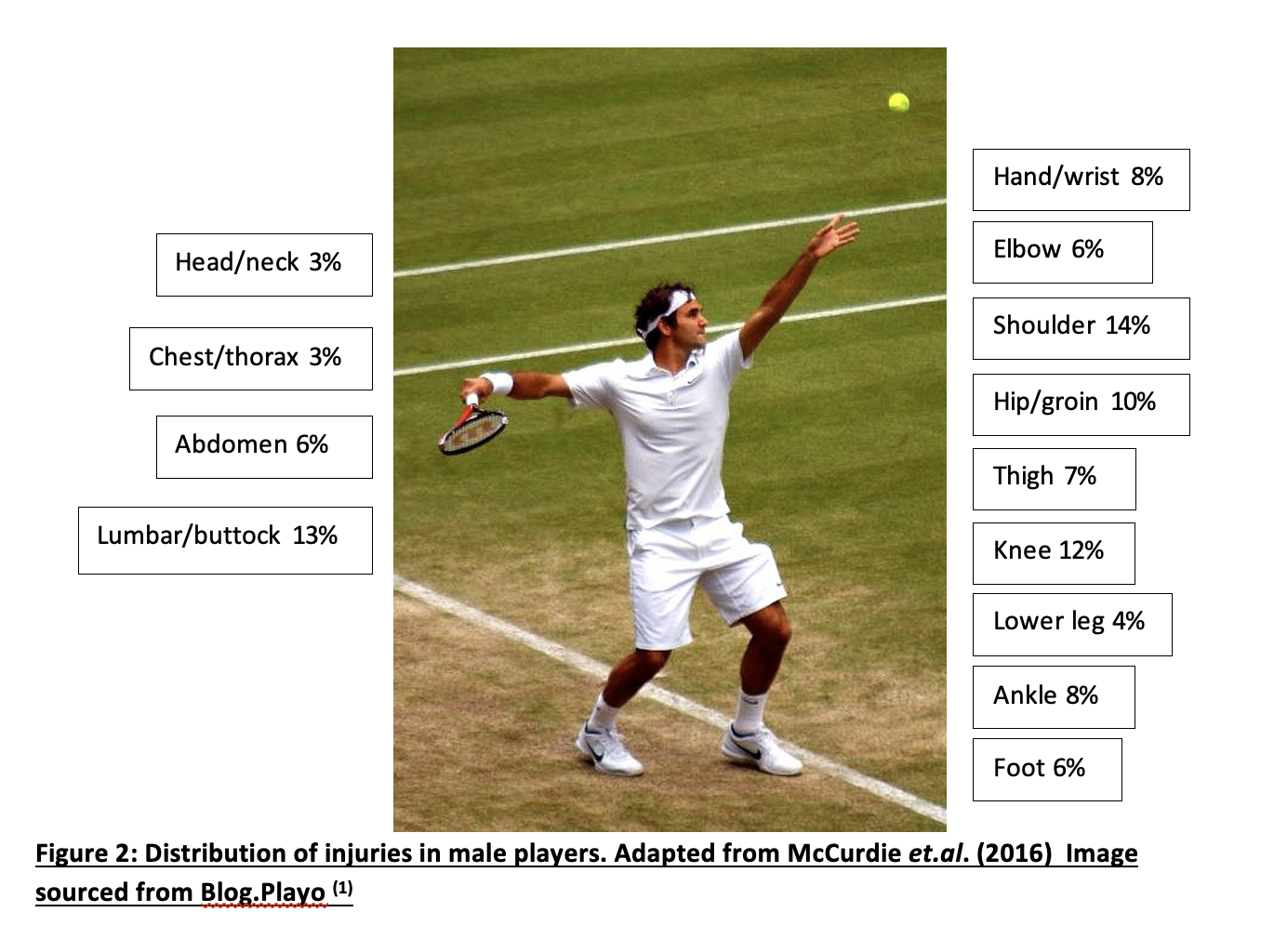
As seen in Figure 2 and 3, the most common injuries in both genders were in the shoulder, knee and lumbar spine. Groin, hip, heel and ankle injuries were more common in males than females, who suffered more wrist and foot injuries. From this we can see that in both genders, injuries in the lower extremities were most common. (3)

Different tennis court surfaces have different properties. For example, on a grass court the ball bounces less and the rallies are shorter. (3) According to Nigg et. al. (1987) playing on various surfaces could be associated with injuries of the lower extremity. They further stated that overuse injuries have become more prevalent since the increased use of artificial surfaces. More research should be done to investigate the association between tennis court surfaces and injuries. (4)
Research determining injury rates in tennis is extremely limited and often has variable outcomes. It is extremely important to determine injury rates in tennis players as it can improve knowledge regarding player care and can lead to the reduction of injuries. So next time you watch Wimbledon, remember – it’s not all just strawberries and cream!
References
- Dharsaun, A., Dharsaun, A., Patel, N. and Patel, N., 2021. These Are The 5 Best Serve Techniques In The History Of Tennis – Playo. [online] Playo. Available at: <https://blog.playo.co/5-best-serving-techniques-tennis-history/> [Accessed 10 April 2021].
- Gordon, A., 2021. Science Explains Why Female Tennis Players Can Serve As Fast As Men. [online] Slate Magazine. Available at: <https://slate.com/culture/2014/09/sabine-lisicki-record-serve-science-explains-why-female-tennis-players-can-serve-as-fast-as-men.html> [Accessed 10 April 2021].
- McCurdie, I., Smith, S., Bell, P. and Batt, M., 2016. Tennis injury data from The Championships, Wimbledon, from 2003 to 2012. British Journal of Sports Medicine, 51(7), pp.607-611.
- Nigg, B. and Yeadon, M., 1987. Biomechanical aspects of playing surfaces. Journal of Sports Sciences, 5(2), pp.117-145.
- Robert H. Shmerling, M., 2021. The gender gap in sports injuries – Harvard Health Blog. [online] Harvard Health Blog. Available at: <https://www.health.harvard.edu/blog/the-gender-gap-in-sports-injuries-201512038708> [Accessed 13 April 2021].
- Sallis, R., Jones, K., Sunshine, S., Smith, G. and Simon, L., 2001. Comparing Sports Injuries in Men and Women. International Journal of Sports Medicine, 22(6), pp.420-423.
The Knee-d to run
by Shana-Lee Bownes
Lockdowns that had us all cooped up in our homes for over a month seems to have sparked a greater appreciation for exercise in us all. Who can forget how ironically crowded the Cape Town beach front walkway was on the 1st May 2020 with walking folk and runners eagerly tottering about with mask-concealed smiles.
Running is arguably one of the most accessible forms of exercise and a popular choice adopted by many trying to stay fit and get outside, especially during the hard lockdown. A survey conducted by De Jong and colleagues (2021) about running during the pandemic found a small but significant increase in running mileage of 1,4km per week (great) but also a 1,4 times the injury risk compared to before the pandemic (not so great)(DeJong, Fish et al. 2021).
Here’s the story: We dust off out running shoes and hop on the road. The first few training sessions are rough, but then they get easier and that’s when the bug bites. Suddenly you’re up at 5am on a Saturday for your long run and posting a snap of your coffee #postrunfeels. But that little niggle in your knee that gradually builds up as you run is still there and often when niggles are ignored they have the potential to turn into more serious injuries. When looking at the studies published in running injuries van der Worp and colleagues found that injury was reported between 19,8-25% in men and 79,1-79,5% in women who run (van der Worp, ten Haaf et al. 2015).
Research on running injury prevention has unfortunately been somewhat inconclusive. Messier and colleagues have undertaken a very important step to improve research in this area by unpacking all of the different factors that contribute to developing running injuries. Over a two year period they followed 300 runners, testing running specific, physical and psychological characteristics. During the study 66% of participants sustained injuries in the two year period. Expressing more negative emotions, being a female and knee stiffness was associated with injury, this is unsurprising considering knee injuries were most commonly reported. Knee stiffness, especially in those weighing 80+ kilos, significantly increased the chances of developing one of those pesky overuse injuries (Messier, Martin et al. 2018).
So, where to from here? Hopefully with this knowledge we can focus our efforts on discovering the mechanisms by which these risk factors contribute to injury. Hopefully by addressing these risks we can come up with strong preventative measures. Measures will translate well into the running community and when implemented – will protect us against injury.
Until then in the wise words of Dean Karnazes: “Run when you can, walk if you have to, crawl if you must; just never give up.” (Meuller 2020)
References
DeJong, A. F., P. N. Fish and J. Hertel (2021). “Running behaviors, motivations, and injury risk during the COVID-19 pandemic: A survey of 1147 runners.” PLOS ONE 16(2): e0246300.
Messier, S. P., D. F. Martin, S. L. Mihalko, E. Ip, P. DeVita, D. W. Cannon, M. Love, D. Beringer, S. Saldana, R. E. Fellin and J. F. Seay (2018). “A 2-Year Prospective Cohort Study of Overuse Running Injuries: The Runners and Injury Longitudinal Study (TRAILS).” Am J Sports Med 46(9): 2211-2221.
Mueller, S (2020). “60 Inspiring and Motivating Running Quotes” [online] Planet of Success. Available at: <http://www.planetofsuccess.com/blog/2017/motivating-running-quotes/> [Accessed 11 April 2021].
van der Worp, M. P., D. S. ten Haaf, R. van Cingel, A. de Wijer, M. W. Nijhuis-van der Sanden and J. B. Staal (2015). “Injuries in runners; a systematic review on risk factors and sex differences.” PLoS One 10(2): e0114937.
 Rugby Science