Category: Uncategorized
The Visual Skills that shape every rugby players performance: Part 2
The second, practical, instalment of this series from our resident eye expert, Grant Van Velden(@gvanvelden) who is a Sports Vision and Decision Making Specialist working out of the Centre for Human Performance Sciences at Stellenbosch University.
He has worked with Australian rugby stars James O’Connor and Quade Cooper, Springbok’s Juan de Jongh, Gio Aplon, Elton Jantjies, Morne Steyn & Pat Lambie,, the Springbok Sevens team, the Maties Referees Academy, Varsity Cup and Young Guns teams, Alan Zondagh’s Rugby Performance Centre (RPC), as well as South African kicking guru’s Braam van Straaten, Louis Koen and Vlok Cilliers. He is also the technical spokesperson for Nike Vision South Africa.
Today’s article will look at three of the visual skills that stand out for me as crucial skills needed for rugby players. These visual skills are Eye-Hand Coordination, Eye-Body Coordination and Peripheral Awareness, three visual skills that any rugby player needs to master in order to perform successfully at the elite level. I will also provide you with a very basic visual skills training drill that you can do to improve a particular visual skill and in doing so, improve your performance on the rugby field.
Although both Eye-Hand Coordination and Eye-Body Coordination are separate visual skills as per definition, I like to group them together when I look at rugby due to the dynamic nature of the game where both visual skills are constantly overlapping one another. However, for definition purposes I will refer to them separately for now.
Eye-Hand Coordination refers to how quickly and accurately an athlete’s muscles and limbs react to visual input received by the eyes. Eye-hand coordination affects your timing, reaction speed, body control and balance. Numerous studies across various sports have shown that eye-hand coordination speed is faster among athletes when compared to non-athletes. In addition, studies have shown it to be a characteristic which distinguishes expertise levels among athletes.
Eye-Body Coordination refers to the ability to make synchronised motor (body) responses to visual input received by the eyes. As you can already see, this definition is very similar to that of eye-hand coordination. It is for this reason that I like to group them together when looking at rugby because there are very little instances in the game where the two visual skills occur in isolation from one another. For example, a jumper in the lineout jumping to catch a ball requires good eye-hand coordination to successfully catch the ball, but at the same time requires good eye-body coordination in order to put his body in the correct position in order for him to successfully catch the ball.

A player that stands out for me as one that possesses very good eye-hand coordination and eye-body coordination is Israel Folau. The code switching Aussie was immense on the counter attack and under the high ball during the British and Irish Lions tour, both skills that require good eye-hand coordination and eye-body coordination. Taking the high ball successfully requires a player to execute his jump for the ball at the precise time so that he catches the ball when he reaches the highest point of his jump. At the same time he has to position his body in a way that he protects himself from oncoming defenders and also does not knock the ball on if he does fumble the ball. This skill requires both good eye-hand coordination as well as good eye-body coordination. On attack, good eye-hand coordination is needed to accurately handoff off a defender and also to make a successful pass to a team mate. Eye-body coordination is need to side-step a defender as well as to put your body into the correct position when taking contact so as to protect the ball. All of these situations require both good eye-hand coordination and eye-body coordination.
Rugby players with great “field vision” are often stared at in amazement as they manage to do the impossible on the rugby field, almost like some God-given talent has been given to them that allows them to see things out of the corner of their eyes that us mere mortals have no chance of seeing, ever! I often make reference to Sonny Bill Williams and his incredible ability to make these unbelievable offloads to team mates in the contact situation. I have heard commentators and rugby fans this season say, “Wow!! How did Sonny Bill do that?? He must have brilliant peripheral vision!!” While this may seem true while watching him execute his amazing ball skills, it is actually anatomically impossible for this to be the case. Commentators, rugby spectators, and players who make these claims of unbelievable peripheral vision actually mean that these exceptional gifted rugby players are more aware of what is in their peripheral visual field than their competitors, a visual skill known as Peripheral Awareness.. SBW’s peripheral awareness helps him to sum up what is going on around him quickly, so that he can react accordingly and very often that reaction is something spectacular like in the image below!!

So if these visual skills are so important, how can you improve them in order to improve your game? One of the easiest and most practical ways to improve your eye-hand coordination as well as your peripheral awareness is to learn how to juggle. By clicking on this hyperlink (http://learnhowtojuggle.info/), you will get access to a website where they give you the basic instructions on how to teach yourself to juggle. Juggling is a fantastic skill to master and will definitely help your eye-hand coordination as well as your peripheral awareness. Once you have mastered the skill of juggling, you can introduce a wobble board or some sort of similar unstable surface to challenge your eye-body coordination. Once this gets too easy, challenge yourself even further by juggling while walking around a room. At the same time that you are walking around the room, try to stay aware of what is going on around you or what you can see in your periphery by verbally expressing what you can see happening in the environment around you. Australia’s Digby Ioane is seen juggling rugby balls in the image below.

As always, keep your body fit and your eyes fitter!!
Two for Tuesday: “Two-a-days” and Secondary Prevention/”Second Impact Syndrome”
 Clinical Journal of Sport Medicine Blog
August. How did that happen?
It’s Tuesday, and it’s still July; but August 1 is a mere two days from now, and in the United States that means football season is cranking up (the NFL opened their training camps last week, with injuries already mounting). August has represented historically the time of year when football teams run their notorious “Two-a-days”: workouts morning and afternoon, intended to prepare the youngsters for the battles of the season (and weed out the poorly conditioned or poorly motivated.)
Two-a-days and August have typically represented a pair that leads to increases in Exertional Heat Illness (EHI), which is definitely something I plan to talk about later in the month. The epidemiology of EHI in High School athletes is something that has been explored recently by Dawn Comstock and her group, a team of researchers I have profiled before in these blog pages.
View original post 389 more words
David vs Goliath: On the complexity of talent identification
Thanks to Ziyaad Parker, one of the authors of the full text reference, for this article. Follow Ziyaad on twitter: @ZiyaadParker7 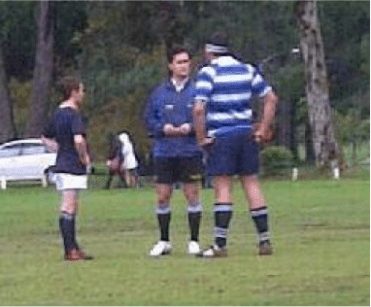 These two players (left and right) are opposing captains of their respective under-14 (i.e. 13 year old) rugby teams in Cape Town, South Africa. For reference, the referee (middle) is of average height ( about 6 ft.).
Attempting to identify a future Goliath is hampered by this stat: only 31% of players selected at U13 Craven Week appear at the U18 Craven Week a few years later 1.
That’s correct, talented young players do not necessarily become talented older players – in fact, more often than not, they don’t: the majority of players selected for the U13 Craven Week do not go on to be selected at subsequent U16 Grant Khomo and U18 Craven Week. There are two theories which try to explain these findings i.e. the attributes that determine success at U13 level are different to those that determine success at U16 and U18 level; or the player has characteristics associated with success in rugby but those characteristics change over time. Growth and maturation occur between the age groups in question (13-18 years). As each individual is not the same as the next, this process occurs at different rates resulting in some 13 year olds being taller and heavier than other 13 year olds (See picture). However, by the time both players reach 17 years old the advantage that an early-maturer had over a late-maturer, in terms of size, may have diminished thus resulting in an even playing field for both players in that regard.
Talent identification is a complex process especially in a sport like rugby in which size is related to performance. Therefore, predicting future success from participation in junior tournaments such as U13 Craven Week may not be accurate as so few players convert U13 success to success at U18 level.
Reference (full text freely available)
1. Durandt, J., Parker, Z., Masimla, H., and Lambert, M. Rugby-playing history at the national U13 level and subsequent participation at the national U16 and U18 rugby tournaments. South African Journal of Sports Medicine 2011;23(4)
 Rugby Science