Rugby-style tackling in American Football
2016seahawkstacklevideo

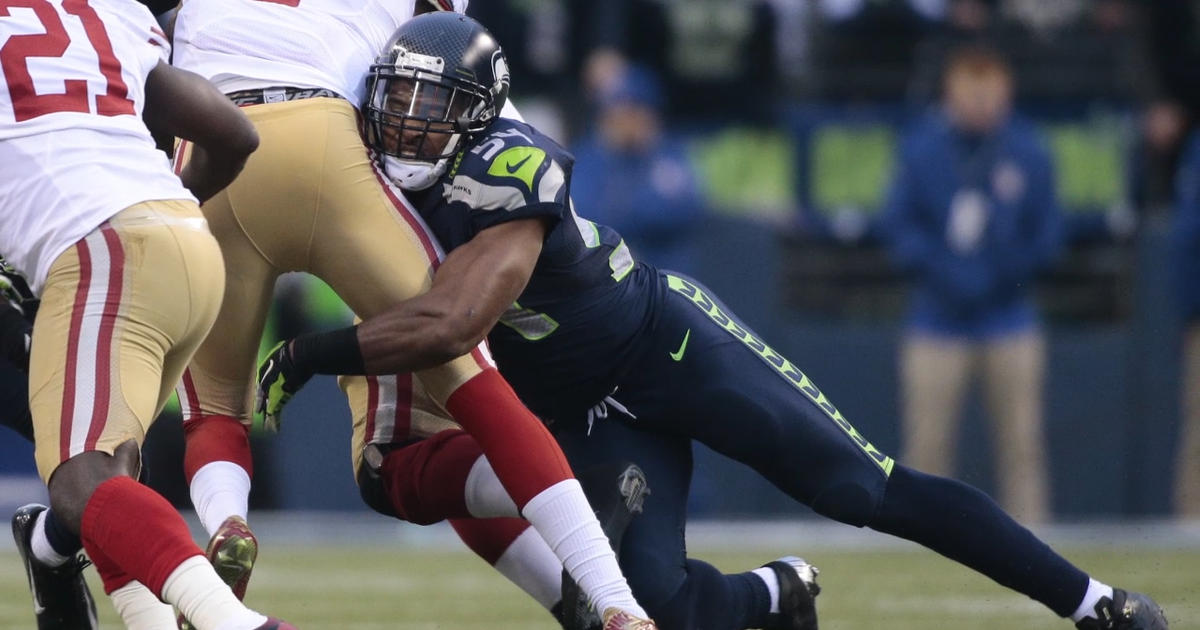
There’s less than a week left until the kick-off of the 2016/2017 NFL season. The question is, will we see more coaches implementing rugby tackle training into their practice sessions?

The current Seattle Seahawks coach, Pete Carroll, has overseen the introduction of rugby tackle technique training in his team’s practice sessions since he took over in 2010. The emphasis of this is to use the shoulder as the primary point of contact during tackling and to avoid direct contact with the head. Here is the franchise’s tackling instructional video for those of you who have not yet seen it. The Seahawks boast quite an impressive recent performance record as they have qualified for the play-offs in five of the past six seasons, were winners of Super Bowl XLVIII in the 2013/2014 season, and were runners-up in Super Bowl XLIX in the 2014/2015 season. Their success is often attributed to their highly efficient and stingy defensive unit. Could this be in part due to the introduction of this rugby tackling protocol?

Research has shown that certain tackling technical criteria are associated with successful tackle outcomes in professional rugby union(Hendricks et al., 2014). Some of these correct tackling cues have also recently been shown to reduce the probability of an injury outcome in general injuries (Burger et al., 2016) and for concussions (Hendricks et al., 2015) in high-level under-18 South African rugby union players. There is limited research exploring the detailed characteristics of tackle technique and associated performance and injury outcomes in American Football (AF). It is worth noting that ‘spear tackling’ in AF i.e. using the helmet as a weapon during head-first tackles, has been outlawed due to the potential risk of catastrophic head and neck injuries (Heck et al., 2004; Boden et al., 2007). It may be valuable to assess the discrete differences between traditional rugby and AF tackling techniques to determine if there are indeed differences in safety and performance outcomes.

Thoughts?

Nicholas Burger @it_is_burger

(PhD Candidate)
Conditioning for Team Sports: Part 2

Determining your Athlete’s Conditioning Profile

When designing your conditioning programme, it is not only important to understand the energy systems that contribute to the success of the particular sport but also the time of the season as well as the level of conditioning that your athlete/s currently possess. Therefore, it is generally advisable to start with some base-line measurement that allows you to identify what your athlete/s require from the programme that you will be compiling.

Generally, I would advise that 1 anaerobic dominant test and 1 aerobic dominant test be used to determine the conditioning profile of your athletes. For the purpose of this post, I will give you two examples of tests that can be performed.

Maximal Aerobic Speed Test (MAS)

The MAS is a very easy to administer test and can be conducted using a cardio modality of your choice. The MAS can be conducted either by using a predetermined distance (1,2 – 5 km) or duration (e.g 4 – 6 min), making it a very popular means of assessing aerobic capacity in athletes.

Some of the variables that you would need to record are as follows;

  • Total Distance
  • Total Time
  • Heart Rate Max

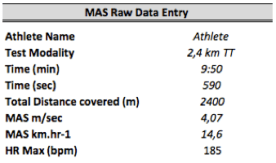
For simplicity, I will use the 2.4 km time trial run as the test of choice. Athletes would need to perform a 2.4 km run over a predetermined course. The time to completion as well as max heart rate should be recorded at the end of the run. Table 1 below is an example of data captured from a 2.4km based MAS test.

Picture4

Picture3

The above data will allow you as an S&C to prescribe your conditioning sessions according to the relative intensity of the individual. This can be done according to distance covered per unit time at a specific percentage of MAS depending on the time of the season and duration of the interval

6 x 30m Repeat Sprint Test

The 6 x 30m repeat sprint test allows you to assess the anaerobic capacity of the athlete. The SUM of the total time to complete all 6 x 30m sprints has been shown to be the most reliable variable, however the % decrement is also a useful variable to use to assess the athletes “drop off”. The table below shows the results of a 6 x 30 test for 5 athletes.

Picture2

By assessing the athletes aerobic and anaerobic capacity you will be able to identify the current condition of your athlete. For example, if your athlete has a really good anaerobic profile but poor aerobic or endurance profile, it is possible that he or she may “tap” into their anaerobic power reserve quicker than they would like and possibly “hit the wall” earlier than expected. This is because the anaerobic energy system cannot sustain the energy production for a prolonged period of time, and if the aerobic system is not well developed this is likely to occur.

Thus if we look at figure 1 below, we will see three different profiles. Say for example these are 3 rugby players, player “A” would likely be the most powerful athlete, however due to the high anaerobic contribution he / she is likely to display signs of fatigue very quickly. Player “B” would be able to produce a fair amount of repeated high-intensity bouts, but would show signs of fatigue quicker than Player “C”, as player “C” has a higher aerobic contribution which will allow him / her to recover quicker from repeated bouts of high-intensity activities. Therefore, even in sports that are dominated by repeated bouts of high-intensity sprints, the aerobic contribution is pivotal to their ability to maintain their power output for prolonged periods of time. It is, however, important to consider how you go about establishing the aerobic capacity in these athletes. This will be discussed in part 3.


Screen Shot 2016-08-09 at 2.31.12 PM

Screen Shot 2016-02-04 at 2.28.32 PM

Hamstring strength & flexibility after hamstring injury

Full Article:

Maniar, Nirav, Anthony J. Shield, Morgan D. Williams, Ryan G. Timmins, and David A. Opar. “Hamstring strength and flexibility after hamstring strain injury: a systematic review and meta-analysis.” British journal of sports medicine(2016): bjsports-2015