As a strength and conditioning coach, there is often a tug-of-war battle between time allocated to getting strong and time allocated to increasing an athlete’s work capacity through conditioning. More often than not, the latter ends up on the losing side. However, strength and conditioning coaches should be mindful that if an athlete’s work capacity is ignored too often, the strength training will be of little value in the team performance setting.
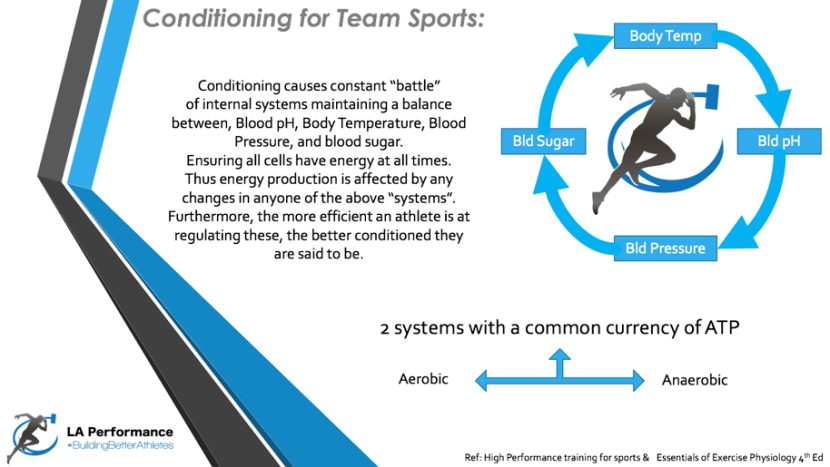
Conditioning strategies for athletes need to be considered as a fundamental part of their overall training plan. Conditioning, also known as “energy system development”, is fundamental to ensuring that homeostasis is maintained during competition by ensuring a balance in all internal systems. Changes in body temperature, blood pH, blood sugar and blood pressure all affect the production of energy (ATP) in some way or another. So as stated by Joel Jamison in High-performance training for sports2015; “it is the biological drive to produce energy and survive that makes it possible to reach the limits of human performance through specific training”.
It’s important to understand that it is not just the heart and working muscle that contribute to elite level sporting performance. The brain itself can respond to very high-intensity exhaustive exercise, by increasing the amount of glycogen it stores locally to make it better equipped to meet the demands of the exercise. Furthermore, the brain also regulates blood flow, hormones, as well as energy production and expenditure.
Before designing any conditioning program, it is essential that you have a thorough understanding of the energy demands of the sport you are dealing with. If the incorrect conditioning programs are implemented, a noticeable drop in performance will be observed.
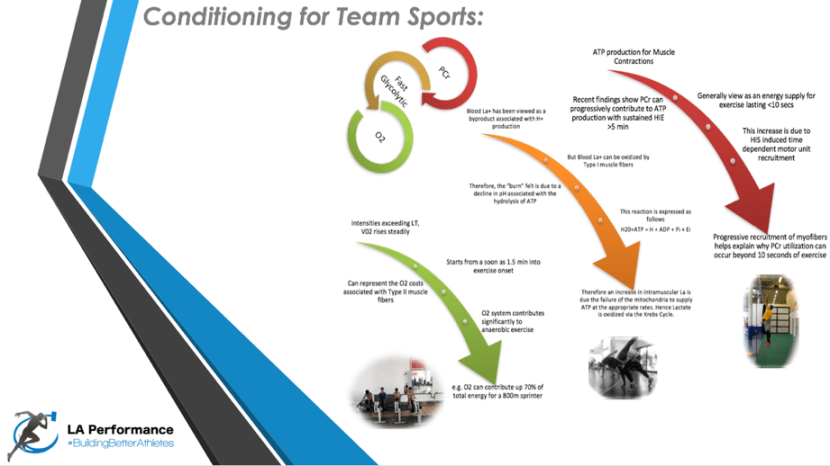
Conditioning for sports functions on the relationship between maximum rate of energy production and maximum duration of energy production. For example, sports that require a very high RATE of energy production are by nature anaerobically dominant whereas sports that require a lower RATE of energy production are generally aerobic in nature (see figure below). For optimal performance, sports requiring higher rates of energy have a higher level of force and power output, and it is the anaerobic system that can generate ATP fast enough to ‘feed’ these systems. Sports that require energy over a prolonged period of time at a slower rate, are generally more efficient and economical in their energy production and utilization.

Take home thoughts:
- Understand the specific energy system that is dominant in your sporting code.
- Understand the rate of energy production as well as the duration of energy production during various conditioning drills and ensure your output matches the demands of the sport at the right time in your programming.
Recommended Reading:
- High-Performance Training for Sports; 2015
- http://www.8weeksout.com ; Joel Jaimeson; Ultimate MMA conditioning
- Is long slow distance necessary for anaerobic athletes?; Murchal et al; 2013 JSCR


 Rugby Science