Overview of the latest research on the tackle in youth rugby
by Nicholas Burger
The tackle is an intrinsic part of rugby union. It is a display of physical strength and technical proficiency and is a skill that is required across all playing positions. It is also responsible for a large proportion of injuries in the sport. Research pertinent to the tackle in rugby union and associated aspects of safety and performance has been conducted predominantly in senior playing cohorts (Quarrie and Hopkins, 2008; McIntosh et al., 2010; Fuller et al., 2010) and less is known about youth levels of the game. The following article highlights current literature available regarding tackle safety, injury and performance in rugby union, particularly at the youth level.
Injury epidemiology
Injury rates in youth rugby union are high in comparison to other team sports, and this is primarily due to the tackle. The incidence rate in under-13 South Africa rugby is 50.0 injuries per 1000 exposure-hours (Burger et al., 2014). It is important to note that the tackle is the most frequently occurring contact event in rugby and, therefore, may not carry a high propensity to cause injury (number of injuries per event) in comparison to other less frequent forms of contact, for example the scrum. However, further research at the youth level is required to determine this.
Between 2008-2011, eight tackle-related injuries in South Africa resulted in a permanent ASCI (acute spinal cord injury) (Brown et al., 2013). Only one of these injuries occurred to a junior (under-9 to under-17) rugby union player.
Injury surveillance was conducted for under-13, under-16, and under-18 age groups over 3 years at the South African Rugby Union Youth Week tournaments, with 7216 players participating in 531 matches between 2011 and 2014. Across all 3 age groups over the 4 monitored years, one hundred and eight concussion events were recorded at a rate of 6.8/1000 player-match-hours (95% CI, 5.5-8.1). Of the one hundred and eight concussions, 62% occurred in the tackle (McFie et al, 2016). Further analysis of the concussion injury mechanism in the undr-18 cohort found that players who failed to execute certain techniques substantially increased the potential for concussion (Hendricks et al. 2015).
Technique
Recent research has shown that under-18 rugby union players who demonstrate poor tackle technique (for tackling and ball-carrying) are at a greater risk of being injured (Figure 1 and Figure 2, Burger et al., 2016). This is the first time this aspect of tackling has been studied in youth level rugby union. Findings from this research advocate and add to the current coaching guidelines on safe tackle technique, which is also the most effective technique (Hendricks et al., 2014).

Figure 1: Ball-carry technique proficiency scores comparing injury vs. non-injury for front-on and side-on tackles.
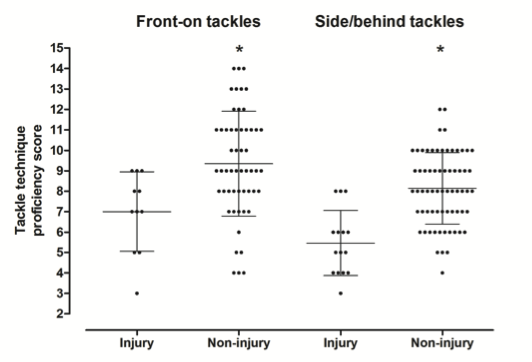
Figure 2: Tackler proficiency scores comparing injury vs. non-injury for front-on and side-on tackles.
A study comparing the tackle-related injury rates and characteristics of varying levels of rugby union in Australia observed that junior players (under-15) were significantly less like likely to be injured in a tackle when compared to senior professional players (McIntosh et al., 2010). This finding may be attributed to the lower playing intensity and impact forces that occur in youth rugby union.
It is noteworthy that a study in youth ice hockey found that under-13 players who had previously participated in non-contact (no body-checking) forms of the game were at a higher risk of being injured during contact in comparison to players who had previously experienced body-checking (Emery et al., 2011). This increase in injury risk may be attributed to a lack of physical preparedness and technical proficiency (Hendricks et al., 2015).
Player conditioning
Repetitive tackling and contact load may result in acute and chronic fatigue which may predispose rugby players to injury (Hendricks and Lambert, 2014). Physiological and anthropometric conditioning are prerequisite to participating in rugby union and go hand-in-hand with well-developed technical proficiency (Gabbett, 2008; Hendricks and Lambert, 2014).
Player knowledge, attitude and behaviour
Research has shown that junior rugby players tend to place dominating the tackle as a priority over safety for themselves or their opponent (Hendricks et al, 2012). Junior players should not only be physically conditioned for rugby and contact situations but it is clear that these players may also require psychological conditioning informing them of the benefits of performing safe tackle technique (which may also be the most beneficial towards a successful performance outcome). This may be achieved through educational safety programmes.
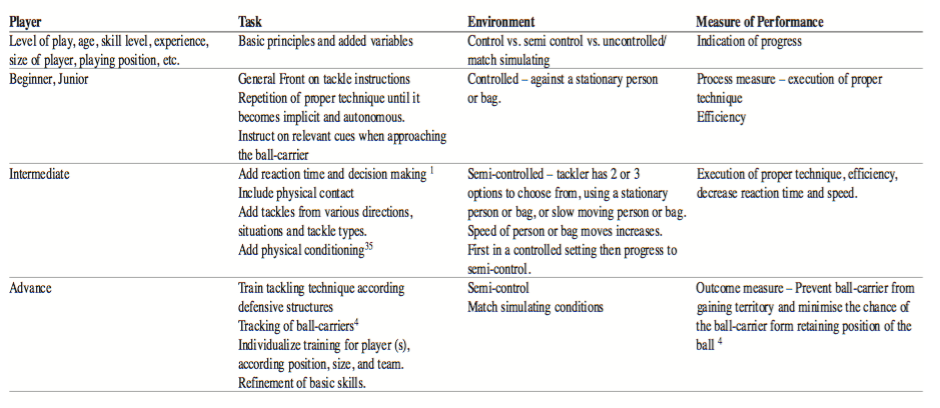
Guidelines for Tackle Skill Development
In 2010, Hendricks and Lambert (2010) proposed guidelines to development tackle technique based on the literature available at the time.
Safety and educational programmes
There are numerous rugby safety programmes available that disseminate educational guidelines for coaches, parents, players and medical professionals. These programmes (BokSmart, RugbySmart, World Rugby) include specific information regarding safety during contact and tackles, and provide advice to ensure that players are physically conditioned and prepared for participation (Quarrie et al., 2007; Brown et al., 2015).
In addition to the research…
Legislation
The tackle is a highly dynamic and open phase of play. As a result, it is more difficult to regulate and control in comparison to set-piece plays including the scrum and line-out. However, over the years, World Rugby has developed and implemented game laws to combat dangerous behaviour during tackles. These laws state that a player ‘a player must not tackle (or try to tackle) an opponent above the line of the shoulders even if the tackle starts below the line of the shoulders’ (Law 10.4e) and ‘a player must not charge or knock down an opponent carrying the ball without trying to grasp that player (Law 10.4g) (World Rugby Law 10). These laws apply to all levels of play.
Conclusion
From the above it is evident that a concerted effort is being made to make contact situations, particularly the tackle, safer for participants at all levels of rugby union. While injury surveillance forms a crucial part of injury epidemiology research, it alone cannot guide injury prevention solutions. It is important to also identify the circumstances and factors which contribute to the manifestation of injuries. These factors are often modifiable and may be controlled to reduce the burden and incidence of injury.
Youth rugby union players should be physically and mentally conditioned to cope with contact, safe and effective tackle technique should be emphasised during training sessions, referees and match officials must ensure that the laws of the game pertinent to contact and foul play are stringently adhered to, and safety and educational guidelines must be distributed widely amongst all stakeholders in youth rugby union.
Nicholas Burger is a PhD candidate at the Division of Exercise Science and Sports Medicine (ESSM), University of Cape Town. He is investigating the mechanisms of injuries during tackles and novel methods to reduce the incidence of these injuries.
References
Brown JC, Lambert MI, Verhagen E, et al. The incidence of rugby-related catastrophic injuries (including cardiac events) in South Africa from 2008 to 2011: a cohort study. BMJ Open 2013;3(2):e002475.
Brown JC, Verhagen E, Knol D, et al. The effectiveness of the nationwide BokSmart rugby injury prevention program on catastrophic injury rates. Scandinavian Journal of Medicine and Science in Sports 2015;doi: 10.1111/sms.12414.
Burger N, Lambert MI, Viljoen W, et al. Tackle-related injury rates and nature of injuries in South African Youth Week tournament rugby union players (under-13 to under-18): an observational cohort study. BMJ Open 2014;4:e005556.
Burger N, Lambert MI, Viljoen W, et al. Tackle technique and tackle-related injuries in high-level South African Rugby Union under-18 players: real-match video analysis. British Journal of Sports Medicine 0:1-8, 2016.
Emery C, Kang J, Shrier I, et al. Risk of injury associated with bodychecking experience among youth hockey players. Canadian Medical Association Journal2011;183(11):1249-1256.
Fuller CW, Ashton T, Brooks JHM, et al. Injury risks associated with tackling in rugby union. British Journal of Sports Medicine 2010;44:159–167.
Gabbett TJ. Influence of fatigue on tackling technique in rugby league players. Journal of Strength and Conditioning Research 2008;23:540–548.
Hendricks S, Jordaan E, Lambert MI. Attitude and behaviour of junior rugby union players towards tackling during training and match play. Safety Science 2012;50:266–284.
Hendricks S, Matthews B, Roode B, Lambert M. Tackler characteristics associated with tackle performance in rugby union. European journal of sport science. 2014;14:753-762.
Hendricks S, Lambert M. Tackling in rugby: Coaching strategies for effective technique and injury prevention. International Journal of Sports Science and Coaching. 2010 1;1:117-36.
Hendricks S, Lambert MI. Theoretical Model Describing the Relationship between the Number of Tackles in Which A Player Engages, Tackle Injury Risk and Tackle Performance. Journal of Sports Science and Medicine 2014;13:715-717.
Hendricks S, O’connor S, Lambert M, Brown J, Burger N, Mc Fie S, Readhead C, Viljoen W. Contact technique and concussions in the South African under-18 Coca-Cola Craven Week Rugby tournament. European journal of sport science. 2015;15:557-64.
Mc Fie S, Brown J, Hendricks S, Posthumus M, Readhead C, Lambert M, September AV, Viljoen W. Incidence and Factors Associated With Concussion Injuries at the 2011 to 2014 South African Rugby Union Youth Week Tournaments. Clinical Journal of Sport Medicine. 2016 doi: 10.1097/JSM.0000000000000276.
McIntosh AS, Savage TN, McCrory P, et al. Tackle characteristics and injury in a cross section of rugby union football. Medicine and Science in Sports and Exercise 2010;42:977–984.
Quarrie KL, Gianotti SM, Hopkins WG, et al. Effect of nationwide injury prevention programme on serious spinal injuries in New Zealand rugby union: ecological study. BMJ 2007;334:1150.
Quarrie KL, Hopkins WG. Tackle injuries in professional rugby union. American Journal of Sports Medicine 2008;36:1705–1716.



 Rugby Science