Managing the acute : chronic workload ratio among team sport athletes

Managing the individual in a team sport environment is one of the greatest challenges but one of the most crucial aspects to the collective success of the team. Training and performance share a complex relationship, which is based on several factors, many of which are unique to the specific individual and the performance task. Therefore, athlete monitoring has become a popular trend among strength and conditioning coaches1.

Monitoring training loads is one of the simplest ways to determine the athlete’s response to the training stress over a period of a time. By monitoring what an athlete has performed in a week (Acute workload) compared to what he has been prepared for (Chronic workload), the strength and conditioning coach can begin to build trends in predicting injury risk. Predicting and ultimately preventing injury is the “Holy Grail” in athlete performance. The Chronic workload can be determined as an athlete’s state of fitness, whereas the acute workload can be determined as the athlete’s state of fatigue2. The difference between the positive function of fitness and the negative function of fatigue produces either a positive (where the chronic workload is above the acute workload) or a negative (where the chronic workload is below the acute workload) training-stress balance. The assumption is that physical preparedness grows as chronic workload outweighs acute workload2 – suggesting that as fitness improves and fatigue is reduced, the performance of the athlete should improve. However, if acute workload outweighs chronic workload, the athlete is at an increased risk of injury – especially in the week following a negative training-stress balance.
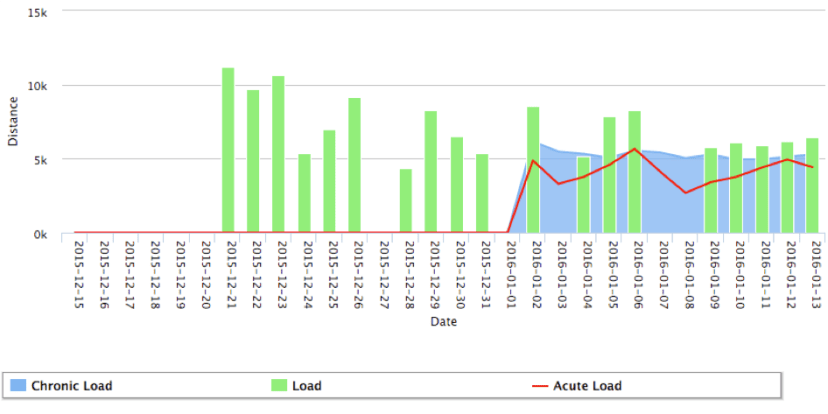
load

The above graph shows an example of a training phase depicting chronic workload, acute workload and daily workload. This is indicative of a positive training-stress balance as the athlete’s chronic workload outweighs the acute workload over a period of time.

It is important to note that a sudden spike in daily training load will increase the athlete’s acute workload while decreasing the chronic workload2, potentially leading to a negative training-stress balance and increased risk of injury in the 1 week following.

A more recent calculation in the form of a ratio provides defined thresholds with quick and easy feedback. The acute:chronic workload ratio indicates that a player is less resistant to injury when subjected to spikes in acute workload, which equates to very-high acute:chronic ratios ~ 1.53.

THE CHRONIC:ACUTE TRAINING LOAD RATIO

In the current week, a very high acute:chronic workload (>2.11) in combination with a very high acute workload is associated with an increased risk of injury by up to 6.9 times as well as demonstrating a 10 fold increase in injury risk in the subsequent week3.

The acute:chronic workload ratio needs to be analysed in combination. A high chronic workload combined with moderate, and moderate – high workload ratios had a smaller risk of injury than a low chronic workload combined with several acute:chronic workload ratios3. (Additional Reading recommended; Training injury paradox: should athletes be training smarter or harder?; Gabbett, T; BJSM)

It is suggested that monitoring acute:chronic workloads be mainstream practice in elite sport in order to better predict the onset of injury and therefore prevent rather than react. For the most practical application, it is best to monitor the acute to chronic workload ratio during the current week and as an average over two weeks relative to either a high or low chronic workload.

Screen Shot 2016-03-04 at 10.25.29 PM

REFERENCES

  1. Joyce D, Lewindon D. High Performance Training for Sports. Human Kinetics; 2014.
  2. Hulin BT, Gabbett TJ, Blanch P, Chapman P, Bailey D, Orchard JW. Spikes in acute workload are associated with increased injury risk in elite cricket fast bowlers. Br J Sports Med. 2014;48(8):708-12.
  3. Hulin BT, Gabbett TJ, Lawson DW, Caputi P, Sampson J a. The acute:chronic workload ratio predicts injury: high chronic workload may decrease injury risk in elite rugby league players. Br J Sports Med. 2015;33:1-7.
 

Understanding Neuromuscular Adaptations in High Performance Athletes:

Part 3: Testing & evaluating special strength:

With a basic overview and understanding of various neuromuscular adaptations to training, the next aspect which we will look at, is the evaluation of our athlete’s ability to express power as well as what best practice is to improve it.

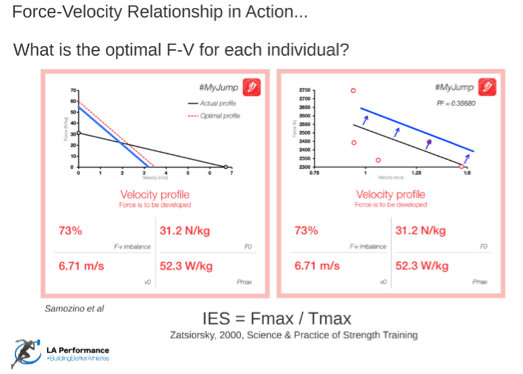
Samozini et al, recently published a study on an iPhone app that allows you to not only determine jump height through flight time but also build a force-velocity profile on your athletes (see figure 1).

Screen Shot 2016-02-04 at 2.08.46 PM

Apps like this are very useful, as they are cost effective, portable, valid and reliable – see link to open source;

(paperhttps://www.researchgate.net/publication/270286306_The_validity_and_reliability_of_an_iPhone_app_for_measuring_vertical_jump_performance)

They allow strength and conditioning specialist to conduct scientific analyses on their athletes with ease, they allow strength and conditioning specialist to conduct scientific analyses on their athletes with ease, and in-turn they gather valuable information from it to allow for better program prescription.

But before we move on, let me introduce you to a few terms that are synonymous with explosive power:

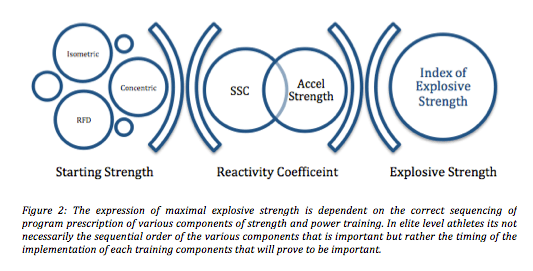
  • Starting Strength: The muscles ability to produce force at the start of the contraction before any external movement occurs.
  • Acceleration Strength: The ability to produce Fmax force as quickly as possible at the start of and isometric or concentric contraction.
  •  Index of Explosive Strength (IES): Is an expression of the of the athletes ability to produce maximal force in the shortest time period. IES = Fmax / Tmax
  • Rate of Force Development (RFD): Rate of rise of contractile force at the onset of a muscle contraction. RFD = Fmax (A) – Fmin (B)/ Time from A – B
  • Reactivity Coefficient (RC): Is the athlete’s explosive strength index relative to their body weight. RC = Fmax / Tmax . W Or RFDmax / W
  • Reactive Strength Index (RSI): The athlete’s ability to produce a maximal concentric contraction in the shortest period of time that is preceded by an eccentric contraction. RSI = Fmax – Fmin / Contact Time
  •  Strength Deficit: The difference in force production between movements incorporating the stretch shortening cycle and movements predominantly utilizing the concentric contraction.

When training for explosive strength we need to consider all the above components of explosive strength, i.e. taking into account the athletes specific neuromuscular structure that is required to produce maximal force as quickly as possible. However, if one of the “links in the chain” is missed, then the expression of Fmax will not be entirely possible. Therefore, when programming with an end goal of explosive strength in mind, we have to consider the full spectrum of strength and power training to ensure that our athletes reap the rewards of true training transfer.

Screen Shot 2016-02-04 at 2.13.17 PM

What are some of the methods used to evaluate explosive strength?

Although it is beyond the scope of this post to discuss all the possible methods of testing explosive strength in detail, I will aim to briefly address some of the most utilized methods in mainstream strength and conditioning.

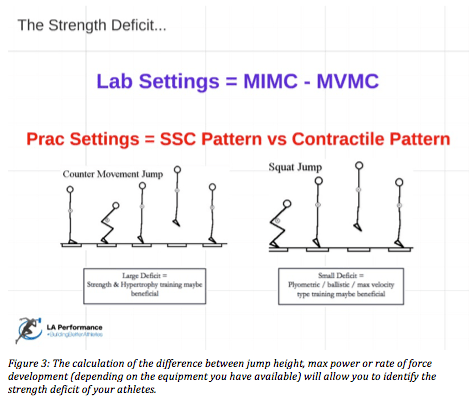
One of the easiest methods of testing your athlete’s strength deficit is by calculating the difference between a countermovement jump height and squat jump height. This will allow the strength and conditioning professionals to identify the areas that their athletes need to work on. For example, a large deficit may indicate that more hypertrophy or strength development is required, whereas a smaller deficit may indicate that more stretch shortening cycle type work is required (See figure 3).

Screen Shot 2016-02-04 at 2.13.51 PM

The use of more expensive equipment such a the GymAware, Fitrodyne, force plates or contact mats allow for many different explosive strength test to be conducted. For example, strength and conditioning coaches are able to create force velocity and power curves with various lifts, such as squats, squat jumps, clean variations, bench press etc, to establish the neuromuscular development of their athletes.

Reactive Strength Index testing is another good measure that can be conducted using a force plate or contact mat. Depth vertical jumps from various heights (e.g. 30cm, 45cm & 60cm) will give you an overview of the reactive strength and neural firing rates of your athletes. This is important because a decrease in neural firing rates will cause a decrease a particular joint stability. The longer it takes for the muscles to contract in a dynamic environment the more susceptible your athlete is to ligamentous injuries.

Rate-of-force development and starting strength can be measured on a force plate with various movements such ad isometric mid-thigh pulls, counter-movement-jumps and squat jumps, just to name a few.

Lastly, some more common test that are used to identify athlete explosive strength with equipment that is more accessible are tests such as; medicine ball chest throws, medicine ball overhead throws, broad jumps as well as vertical jumps.

Screen Shot 2016-02-04 at 2.28.32 PM

Suggested Reading:

Developing maximal neuromuscular power; Part 1: Biological basis of maximal power production; Cormie et al; 2011

Developing maximal neuromuscular power; Part 2: Training considerations for improving maximal power production; Cormie et al; 2011


Grouping players by size, not age?

What are your thoughts on this new trial aiming to group aspiring youngsters by build, instead of age? Have a look at the video and then please feel free to comment below…
Thanks to Grant Van Velden  (@gvanvelden) for sharing the video.