“You can’t manage what you don’t measure.” Monitoring training load and recovery in team sports
Screen Shot 2013-09-06 at 12.28.39 PM

by Ben Capostagno and Wayne Lombard

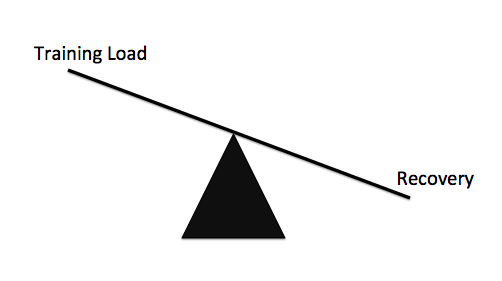
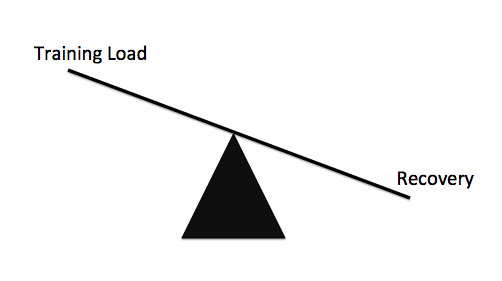
In a recent editorial for the International Journal of Sports Physiology and Performance, Iñigo Mujika highlighted the importance of quantifying training load.(3) If an athlete shows positive adaptation to training, it is important for the strength and conditioning coach to know the exact training load the athlete was exposed to. Likewise if the athlete shows a maladaptation to training, accurately collected training load data will indicate whether the training load was excessive or insufficient. One of the simplest ways to quantify training load is to multiply the duration of the session in minutes by a rating of perceived exertion for the session. For example, if a training session lasts 60 minutes and the athlete rates the session as 5 out of 10 for intensity, the training load should be 300 units.

Once the training load has been accurately quantified it is crucial to monitor how the athletes are responding to the imposed load. Daily monitoring has become more popular within sports science as athletes are constantly exposed to ever increasing training loads. The daily monitoring commonly takes the form of questionnaires and should include a subjective rating of fatigue. In addition, Kenta and Hassmen (2) identified four key areas of recovery that should also be monitored;

  • nutrition and hydration
  • sleep and rest
  • relaxation and emotional support
  • stretching and active rest

If the athlete is actively engaging in these four areas of recovery, but still reporting high levels of fatigue, then the planned training load should be adjusted accordingly.

It is important to partner the subjective measures of recovery with an objective measure. The most common target of objective measures is the autonomic nervous system. The autonomic nervous system is connected to a wide variety of systems within the human body and thus makes it a suitable target to monitor the overall well-being of the athlete.(1) Non-invasive measures of the autonomic system’s status include heart rate variability (HRV) and heart rate recovery (HRR). HRV appears to be gaining momentum as the objective measure of choice within teams and individual athletes. However, there is currently no clear consensus on the measurement and interpretation of HRR and HRV and therefore should be used with caution.

In conclusion there are simple, validated measures of both training load and the athlete’s responses to these training loads. Coaches and strength and conditioning experts are encouraged to use these or similar methods in order to manage their players during a competitive season.


Reference

1.     Borresen J and Lambert MI. Autonomic Control of Heart Rate during and after Exercise : Measurements and Implications for Monitoring Training Status. Sports Medicine 38: 633-646, 2008.

2.     Kentta G and Hassmen P. Overtraining and recovery. A conceptual model. Sports Medicine 26: 1-16, 1998.

3.     Mujika, I. The Alphabet of Sport Science Research Starts With Q. International Journal of Sports Physiology and Performance 8: 465-466, 2013.

About the Authors

Benoit Capostagno completed his BSc degree (cum laude) specialising in the Sport Sciences at the University of Stellenbosch in 2006. He continued his studies at the University of Cape Town’s Research Unit for Exercise Science and Sports Medicine completing his honours with a first class pass in 2007. He is continuing his postgraduate work with his PhD at this same unit and is investigating training adaptation and fatigue in cyclists. He has been a consultant with the Sports Science Institute of South Africa’s High Performance Centre’s Cycling Division since 2009. In addition, Ben has also assisted the Springbok Sevens Rugby team with monitoring the training status and levels of fatigue in their players since the 2008/2009 IRB World Sevens Series. Follow Ben on twitter @BCapostagno

Wayne Lombard completed his undergraduate and honors degrees at the University of Kwa-Zulu Natal (Durban). He then joined the Sports Science Institute of South Africa as a Biokineticist and Performance enhancement specialist at the High Performance Centre. He then went on to complete is Master’s degree and is currently registered for a PhD in exercises science at the University of Cape Town, focusing on athlete monitoring of training loads, recovery and fatigue. Wayne has worked with various of South Africa’s top athletes in all sporting codes, including some of South Africa’s Paralympic and Olympic athletes. Follow Wayne on twitter @waynelombard.  You can also visit the Sport Science Institute of South Africa Website at http://www.ssisa.com/pages/high-performance/-high-performance-services.

The Visual Skills that shape every rugby players performance: Part 2

The second, practical, instalment of this series from our resident eye expert, Grant Van Velden(@gvanvelden) who is a Sports Vision and Decision Making Specialist working out of the Centre for Human Performance Sciences at Stellenbosch University. 

He has worked with Australian rugby stars James O’Connor and Quade Cooper, Springbok’s Juan de Jongh, Gio Aplon, Elton Jantjies, Morne Steyn & Pat Lambie,, the Springbok Sevens team,  the Maties Referees Academy, Varsity Cup and Young Guns teams, Alan Zondagh’s Rugby Performance Centre (RPC), as well as South African kicking guru’s Braam van Straaten, Louis Koen and Vlok Cilliers. He is also the technical spokesperson for Nike Vision South Africa.


Today’s article will look at three of the visual skills that stand out for me as crucial skills needed for rugby players.  These visual skills are Eye-Hand Coordination, Eye-Body Coordination and Peripheral Awareness, three visual skills that any rugby player needs to master in order to perform successfully at the elite level.  I will also provide you with a very basic visual skills training drill that you can do to improve a particular visual skill and in doing so, improve your performance on the rugby field.

Although both Eye-Hand Coordination and Eye-Body Coordination are separate visual skills as per definition, I like to group them together when I look at rugby due to the dynamic nature of the game where both visual skills are constantly overlapping one another.  However, for definition purposes I will refer to them separately for now.

Eye-Hand Coordination refers to how quickly and accurately an athlete’s muscles and limbs react to visual input received by the eyes.  Eye-hand coordination affects your timing, reaction speed, body control and balance.  Numerous studies across various sports have shown that eye-hand coordination speed is faster among athletes when compared to non-athletes.  In addition, studies have shown it to be a characteristic which distinguishes expertise levels among athletes.

Eye-Body Coordination refers to the ability to make synchronised motor (body) responses to visual input received by the eyes.  As you can already see, this definition is very similar to that of eye-hand coordination.  It is for this reason that I like to group them together when looking at rugby because there are very little instances in the game where the two visual skills occur in isolation from one another.  For example, a jumper in the lineout jumping to catch a ball requires good eye-hand coordination to successfully catch the ball, but at the same time requires good eye-body coordination in order to put his body in the correct position in order for him to successfully catch the ball.

Image


A player that stands out for me as one that possesses very good eye-hand coordination and eye-body coordination is Israel Folau.  The code switching Aussie was immense on the counter attack and under the high ball during the British and Irish Lions tour, both skills that require good eye-hand coordination and eye-body coordination.  Taking the high ball successfully requires a player to execute his jump for the ball at the precise time so that he catches the ball when he reaches the highest point of his jump.  At the same time he has to position his body in a way that he protects himself from oncoming defenders and also does not knock the ball on if he does fumble the ball.  This skill requires both good eye-hand coordination as well as good eye-body coordination.  On attack, good eye-hand coordination is needed to accurately handoff off a defender and also to make a successful pass to a team mate.  Eye-body coordination is need to side-step a defender as well as to put your body into the correct position when taking contact so as to protect the ball.  All of these situations require both good eye-hand coordination and eye-body coordination.

Rugby players with great “field vision” are often stared at in amazement as they manage to do the impossible on the rugby field, almost like some God-given talent has been given to them that allows them to see things out of the corner of their eyes that us mere mortals have no chance of seeing, ever!  I often make reference to Sonny Bill Williams and his incredible ability to make these unbelievable offloads to team mates in the contact situation.  I have heard commentators and rugby fans this season say, “Wow!! How did Sonny Bill do that??  He must have brilliant peripheral vision!!”  While this may seem true while watching him execute his amazing ball skills, it is actually anatomically impossible for this to be the case.  Commentators, rugby spectators, and players who make these claims of unbelievable peripheral vision actually mean that these exceptional gifted rugby players are more aware of what is in their peripheral visual field than their competitors, a visual skill known as Peripheral Awareness..  SBW’s peripheral awareness helps him to sum up what is going on around him quickly, so that he can react accordingly and very often that reaction is something spectacular like in the image below!!

Image


So if these visual skills are so important, how can you improve them in order to improve your game?  One of the easiest and most practical ways to improve your eye-hand coordination as well as your peripheral awareness is to learn how to juggle.  By clicking on this hyperlink (http://learnhowtojuggle.info/), you will get access to a website where they give you the basic instructions on how to teach yourself to juggle.  Juggling is a fantastic skill to master and will definitely help your eye-hand coordination as well as your peripheral awareness.  Once you have mastered the skill of juggling, you can introduce a wobble board or some sort of similar unstable surface to challenge your eye-body coordination.  Once this gets too easy, challenge yourself even further by juggling while walking around a room.  At the same time that you are walking around the room, try to stay aware of what is going on around you or what you can see in your periphery by verbally expressing what you can see happening in the environment around you.  Australia’s Digby Ioane is seen juggling rugby balls in the image below.

Image


As always, keep your body fit and your eyes fitter!!

Two for Tuesday: “Two-a-days” and Secondary Prevention/”Second Impact Syndrome”

sportingjim's avatarClinical Journal of Sport Medicine Blog

August.  How did that happen?

It’s Tuesday, and it’s still July; but August 1 is a mere two days from now,  and in the United States that means football season is cranking up (the NFL opened their training camps last week, with injuries already mounting).  August has represented historically the time of year when football teams run their notorious “Two-a-days”:  workouts morning and afternoon, intended to prepare the youngsters for the battles of the season (and weed out the poorly conditioned or poorly motivated.)

Two-a-days and August have typically represented a pair that leads to increases in Exertional Heat Illness (EHI), which is definitely something I plan to talk about later in the month.  The epidemiology of EHI in High School athletes is something that has been explored recently by Dawn Comstock  and her group, a team of researchers I have profiled before in these blog pages. 

View original post 389 more words