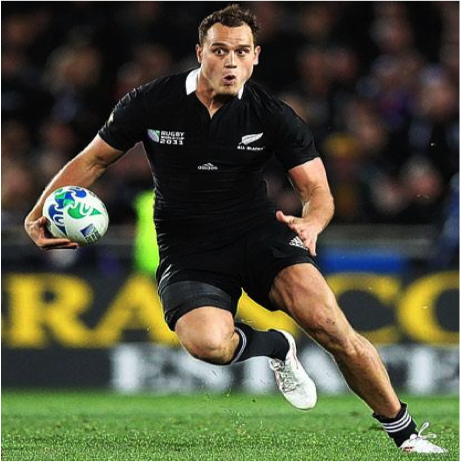
George Smith – Houdini of the Pitch Side Concussion Assessment (PSCA)?


Image


(Picture courtesy of http://www.planetrugby.com)

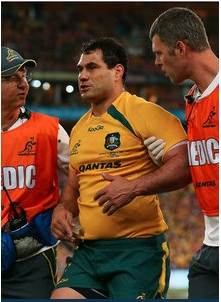
George Smith being allowed to return to the B&I Lions vs Australia final test after a clear cut concussion is indicative of the PSCA being used as a “get out of jail” card. 

The All Blacks version of this test is clear in that it should ONLY be performed for ambigious cases of concussion (http://files.allblacks.com/nzru_media_releases/2012/08_August/ITMC_PSCA_Process.pdf). The test is NOT required for a clear-cut concussion, which has one or more of the following characteristics:

  1. Tonic posturing
  2. Convulsions
  3. Loss of Consciousness (LOC) – as confirmed by medically trained person

Whether medically trained or not, it was obvious both at the time and while watching the many repeats of this incident that Smith had LOC and therefore did not require the PSCA to confirm his diagnosis. Furthermore, he couldn’t walk off the field unaided (not a “definition” of concussion, but noteworthy as to his lack of recovery from the incident).

This is unfortunate as the IRB took an enormous and admirable step in initiating the trial of the PSCA purely on the basis of improving the welfare of it’s players. As with any new trial, there could always be “teething issues” – and I assume this is one such issue that will be resolved quickly so that this test will have the intended effect.


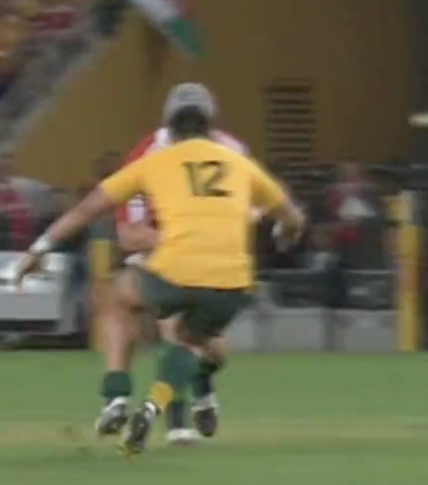
Even players at the highest level get it wrong sometimes…the attempted tackle by Christian Lealiifano on Jonathan Davies

On Saturday 22 June 2013, the British and Irish Lions recorded a historic win over the Wallabies in the First Test (of three) in Brisbane. As the score suggests, it was a fiercely contested match, and made for some entertaining rugby with debutant Israel Folau crossing the try-line twice, George North scoring one of the Lions most memorable tries, and Alex Cuthbert finishing off a well rehearsed Lions backline move. Even though the match was a display of Test Rugby at its best, the match also showed rugby’s unkind side – serious injuries. The Wallabies suffered 3 suspected serious injuries, one of them to another debutant, Christian Lealiifano, during the 1st minute of the game.
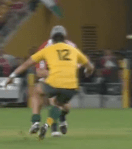
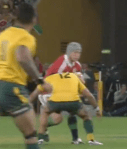
1 2354

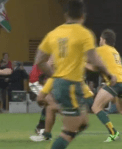
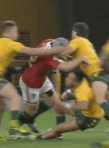
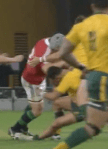
Christian Lealiifano, a physically conditioned 95 kg, started the match at inside centre (usually plays fly-half). From a lineout on the Wallabies 10 metre, the Lions aimed to set up play in the midfield with Jonathan Davies (103 kg) running an almost direct line at the defence. The defender lining up Jonathan Davies, was none other than debutant Christian Lealiifano. Christian Lealiifano was positioned almost directly opposite Jonathan Davies and attempted a front-on tackle. From the match footage, after the contact between the two inside centres, Christian Lealiifano failed to rise to his feet, and showed little or no movement. From the slow motion replay of the attempted tackle, it seemed Lealiifano might have had his head in an unfavorable position, where the vertex (top of his head) was the first point of direct contact with Jonathan Davies causing his neck to flex. From a defense perspective, play was moving from left to right, therefore, it is presumed a standard right shoulder front-on tackle was required.

A couple of points can be made from this unfortunate incident. Firstly, even players at the highest level get it wrong sometimes. Secondly, the importance of head placement and correct technique when executing a tackle. Note, this is not new information. A study conducted by the University of Nottingham, in collaboration with England Rugby Football Union, studied 6219 tackles over 2 English Premiership seasons (2003/2004, 2005/2006) to identify risk factors for tackle injuries 1. In view of this study’s in depth analysis of tackle injury, the attempted tackle by Lealiifano on Davies had all the components to place Lealiifano at high risk of injury. The tackle injury study, published in the British Journal of Sports Medicine (2010), identified the following risk factors for tacklers.

  • Playing position – tackler’s playing 10, 12, or 13 have a higher chance of injury than any other position.
  • Tackler vs Ball-carrier speed – tackler’s attempting to tackle a ball-carrier with a significantly higher speed before entering have a higher probability of injury.
  • Head position before tackle
  • Body region struck – tackler’s are at high risk of injury when contacting the ball-carrier with the head or neck.

In addition to these risk factors, Lealiifano was technically playing out of position, which has been reported to also increase risk of injury in the tackle 2. Though, the positional demands of inside centre and fly-half are fairly similar. Also, it was Lealiifano’s debut match, and his first action of the game. Therefore, perhaps with the intention of making a big impact on his debut, he may have been a bit too eager to make the tackle, and as a result, got the timing wrong and found his head misplaced.

The physical and dynamic nature of the tackle contest places players at high risk of injury. While this risk of injury may always be present during these physical contests between the ball-carrier and tackler, techniques to significantly reduce this risk of injury, and at the same time effective from a performance perspective, have been highlighted previously 3. Lets hope Lealiifano is fit and well soon, and the remainder of matches in the British and Irish Lions Series are both injury free, and highly entertaining.

References

1   Fuller CWC, Ashton TT, Brooks JHMJ, et al. Injury risks associated with tackling in rugby union. Br J Sports Med 2010;44:159–67.

2   Garraway WM, Lee AJ, Macleod DA, et al. Factors influencing tackle injuries in rugby union football. Br J Sports Med 1999;33:37–41.

3   Hendricks S, Lambert M. Tackling in rugby: coaching strategies for effective technique and injury prevention. Int J Sports Sci Coach 2010;5:117–36.

by Dr Sharief Hendricks, follow at @Sharief_H
The Visual Skills that shape every rugby players performance: Part 1

This article is by Grant van Velden (@gvanvelden) who is a Sports Vision and Decision Making Specialist working out of the Centre for Human Performance Sciences at Stellenbosch University.  He has worked with Australian rugby stars James O’Connor and Quade Cooper, Springbok’s Juan de Jongh, Gio Aplon, Elton Jantjies, Morne Steyn & Pat Lambie,, the Springbok Sevens team,  the Maties Referees Academy, Varsity Cup and Young Guns teams, Alan Zondagh’s Rugby Performance Centre (RPC), as well as South African kicking guru’s Braam van Straaten, Louis Koen and Vlok Cilliers. He is also the technical spokesperson for Nike Vision South Africa. 

With the Super 15 heading into a crucial part of the season, I thought that it was fitting to highlight some of the visual skills that the players in the top teams of the tournament would possess.  This will be the beginning of a number of articles that highlight these visual skills.

Today’s article will look at the visual skills of Dynamic Visual Acuity (DVA) and Visual Alignment, two visual skills that any rugby player needs to master in order to perform successfully at the elite level.

ImageDynamic Visual Acuity, also known as kinetic visual acuity, refers to the athlete’s clarity of vision while the athlete is in movement or while the athlete is tracking a moving object – in rugby this would relate to how clearly and precisely the player can send visual information to the brain for interpretation so that the correct motor response can be initiated.  The more clear and precise the visual information, the more accurate is the information that is sent to the brain and the faster the brain is able to process that information.  So a lock forward with good DVA will be able to give clear and precise visual information to his brain regarding the flight of the ball from a kick off, so that his brain can interpret the information an initiate the correct timing of the jump in order to secure the ball for his team successfully.  Eben Etzebeth, one of the top lock forwards in the world, would more than likely excel at DVA task.  This visual skill would also be particularly beneficial for a fullback, such as Willie le Roux, who is tasked with successfully catching aerial bombs while under immense pressure from the opposition.

Visual Alignment is the ability to accurately aim the two eyes at a target, whether stationary or moving.  Most people’s eyes are slightly misaligned, which is normal.  Some athletes with an eye condition (such as lazy eye, turned eye, or crossed eyes) will have a more serious eye alignment problem requiring a doctor’s intervention.  Eye alignment affects the athlete’s perception of the position of the target, as well as the speed and the distance of the target.  As a result, any misalignment can be responsible for errors in aiming, timing, as well as eye-hand or eye-foot coordination.  In addition, misalignment of the eyes can cause the athlete to adopt a poor posture and technique in order to compensate for the visual problem.  Morne Steyn is a prolific goal kicker and is currently one of the leading point scoreres in this years Super 15 – it would not surprise me to find that Morne has a very good visual alignment.  Misalignment could be a huge hindrance if you are a flyhalf wanting to better your goal kicking performance for example, but you just cannot seem to improve beyond a certain point.  If your eyes are misaligned, it could be affecting your kicking technique so much so that you are not consistently striking the ball correctly.

Remember, keep your body fit and your eyes fitter!!

The next article in this series will discuss how to train these visual skills….