Category: Concussion
Legislation effective for concussion prevention/management
SUMMARY: Legislation/regulation is an effective strategy to prevent and manage neurological injuries (including concussion).

The recent article of Gibson and colleagues 1 in JAMA paediatrics indicates that legislation can be effective in improving concussion management in children. Similarly, Cusimano et al. 2 concluded that there is more evidence to support wide-spread mandatory interventions (form of legislation/regulation) than protective equipment for the prevention of rugby-related neurological symptoms. This success could be related to the fact that some form of behaviour change is required if an intervention is to reduce injuries 3. Also, the advantage of legislation is that its effects are not dependent on a specific coach or player 4.
In combination, these two articles would suggest that nationwide prevention programmes such as RugbySmart or BokSmart are useful interventions for preventing and managing rugby-related neurological injuries.
References:
- Gibson TB, Herring SA, Kutcher JS, Broglio SP. Analyzing the Effect of State Legislation on Health Care Utilization for Children With Concussion. JAMA Pediatr. 2014 Dec 22.
- Cusimano MD, Nassiri F, Chang Y. The Effectiveness of Interventions to Reduce Neurological Injuries in Rugby Union: A Systematic Review. Neurosurgery. 2010 Nov;67(5):1404–18.
- Gielen AC. Application of Behavior-Change Theories and Methods to Injury Prevention. Epidemiol Rev. 2003 Aug 1;25(1):65–76.
- Benson BW, MCINTOSH AS, Maddocks D, Herring SA, Raftery M, Dvorák J. What are the most effective risk-reduction strategies in sport concussion? Br J Sports Med. 2013 Apr;47(5):321–6.
Best treatment for concussion involves rehabilitative, sub-symptom exercise
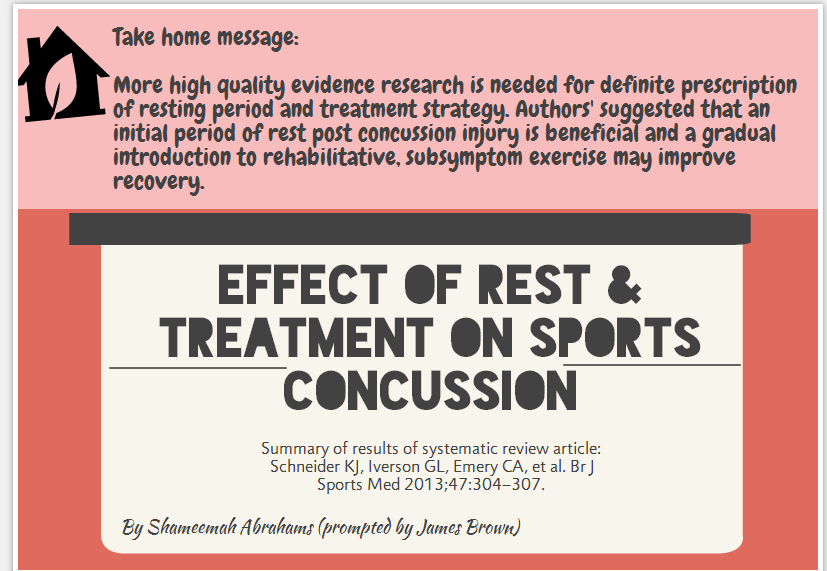
This week, Shameemah Abrahams has made a visual summary of a review article: “Effect of rest and treatment on sports concussion” which appeared in British Journal of Sports Medicine in 2013 (Vol 37, pages 304-307). The authors of the article were: KJ Schneider, GL Iverson, CA Emery, P McCrory, SA Herring and WH Meeuwisse.
You can see Shameemah’s take-home message from this article was in the screenshot of her infographic, below. To view Shameemah’s original infographic click on this link:
https://magic.piktochart.com/output/2075169-rest-and-treatment-for-sports-co
About Shameemah
Shameemah Abrahams majored in Biochemistry and Physiology for her undergraduate BSc (2008 – 2010) with honours in Physiology, specialising in Neuroscience, (2011) at the University of Cape Town (UCT). She is currently in her first year as a Phd student at the UCT/MRC Exercise Science and Sports Medicine research unit, UCT. Her Phd project deals with the identification of genetic and non-genetic predisposing factors of concussion risk in South African rugby players. Her research interests include brain injury, physiological changes during exercise and genetic predisposition to injury.
 Rugby Science