Category: Injury Prevention
Relationship between tackle frequency, injury risk and performance
The tackle is a physical contest between opposing players contending for territory and ball possession. During an 80 minute rugby union match, a player will physically engage in the tackle contest, whether as a ball-carrier or tackler, between 10 to 35 times depending on the position of the player (Deutsch et al., 2007; Quarrie and Hopkins, 2008). During a match, tight forwards (position numbers 1-5, who primarily compete in the set phases such scrums and lineouts) engage in the tackle approximately 10-25 times, loose forwards (position numbers 6-8, who mainly competes for possession of the ball at rucks and assist the tight forwards in set pieces) are involved in 25-35 tackles, inside backs (position numbers 9,10,12,13, whose key responsibility is to execute tactics and distribute the ball) competes in 20-25 tackles, and outside backs (position numbers 11,14,15, who are typically quicker and expected to run into open spaces to cross the advantage line and score points) engage in 10-15 tackles (Deutsch et al., 2007; Quarrie and Hopkins, 2008).

A player requires a high level of skill, physical tolerance and resistance to fatigue to repeatedly engage safely and effectively in the tackle, therefore understanding the physical demands of a tackle is important with many applications such as design and development of proper training drills and equipment, planning and management of training and recovery between training sessions and matches.
The biomechanics of injury risk can be explained by the event either resulting from an overload of the system’s tolerance levels, or a reduction in the system’s tolerance levels through micro trauma to a point where normal loads cannot be tolerated (McIntosh, 2005)
For the tackle, studies have shown a positive relationship between the number of tackles made during matches and markers of muscle damage (Smart et al., 2008; Takarada 2003). Also, repeated tackling decreases the amount of force produced by the tackler, which may be attributed to fatigue (Usman et al., 2011).
In rugby union and rugby league studies, the specific physical and technical requirements for safe and effective contact in the tackle have been highlight (summary of tackler below).
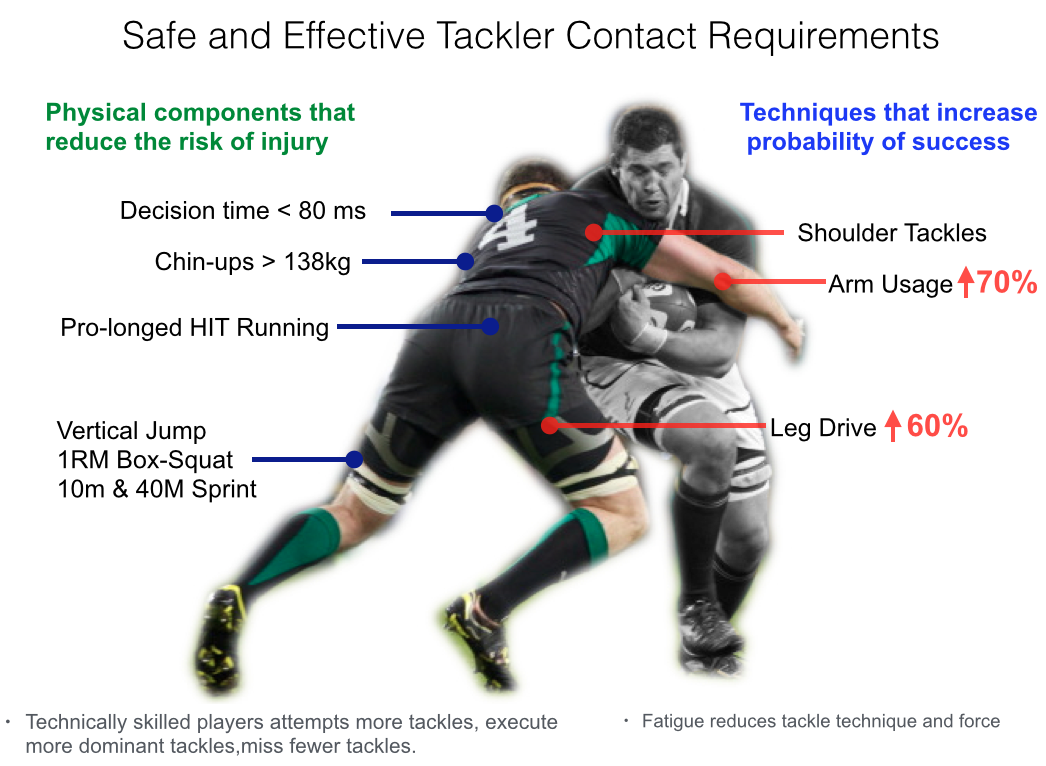
Based on this, we propose a theoretical model for the relationship between the number of tackles in which a player engages in (acute or chronic fatigue), magnitude of impact (energy load), markers of muscle damage (micro trauma) and how this relationship interacts with tackle injury risk (tolerance overload or reduction) and tackle performance (Hendricks and Lambert, 2014).
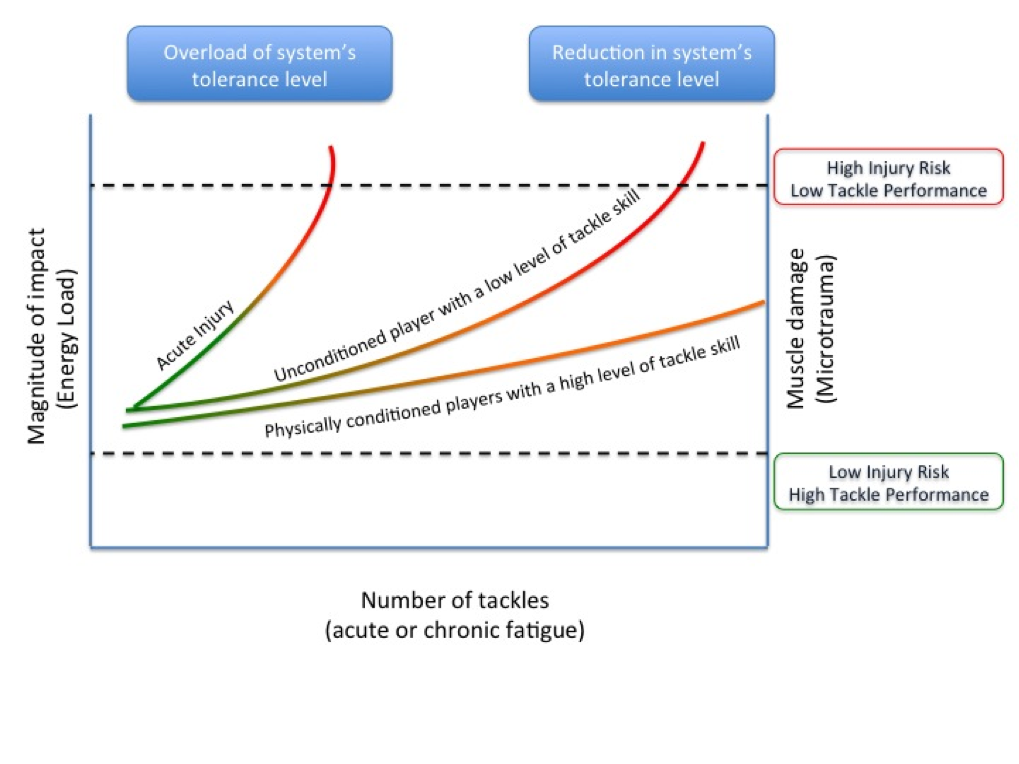 Players may have an upper limit for being able to endure repeated high energy impact tackles. If this upper limit is exceeded the risk of injury is substantially increased, and tackle performance is noticeably decreased (figure below). This upper limit is reached either through one or more very high-energy impact contact situations or, accumulates over a match or season following repetitive lower-energy impact situations. However, effective tackle skill training, proper physical conditioning, strength, power, equipment and attitude/motivation can offset this upper limit (McIntosh, 2005). For example, physically conditioned players with a high level of tackle skill may have the technical ability and physiological capacity to minimise the energy load on the body, thereby increasing their tolerance level for physical loads.
This paper was published in the Journal of Sport Science and Medicine. The full article can be found here http://www.jssm.org/letter.php?id=jssm-13-715.xml .
Sharief Hendricks
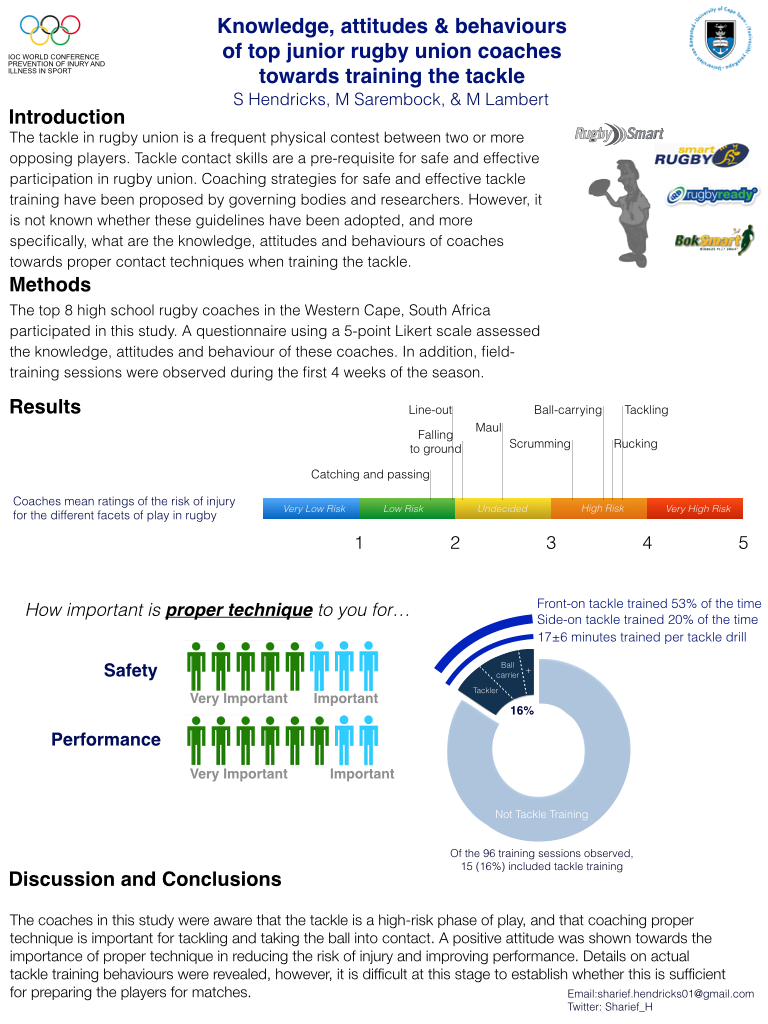
Knowledge, attitudes & behaviours of top junior rugby coaches towards training the tackle
Springbok Captain forced out of World Cup squad through injury
If Jean De Villiers keeps playing as much rugby as he currently is, this fictitious newspaper headline will become an unfortunate reality and South Africans will be left wondering why something wasn’t done about it.

With the Springbok Captain in what some are calling the best form of his life, there should be urgent concern over whether he will be able to compete in the next World Cup. If you are any doubt as to De Villiers being “overplayed”, read this article by Simon Borchardt: http://www.sarugbymag.co.za/blog/details/managing-de-villiers .
So what is the danger of De Villiers playing so much? Quite simply, a severe injury with a long lay-off period that may include the World Cup.
In a previous article we summarised the risk of injury in rugby (http://wp.me/p2UGKS-2U) (1): it doesn’t take a genius to work out that rugby union carries an above-average risk of injury to the general player. However, what experts have discovered is that this risk is even higher for those playing at highly competitive levels. An extended Super 15 season, the Rugby Championship and the Currie Cup final stages would all constitute “highly competitive”. Furthermore, De Villiers has two other risk factors for injury that he can’t do anything about: his (relatively old) age and history of previous injuries (1). Worst of all, there is a final risk factor that De Villiers is being subjected to and, unlike the other injury risk factors, this is something that can be modified: exposure time (2,3). To explain “exposure time” let me ask you this: Who is at greater risk of a suffering a shark attack: the Cape Townian who surfs once a month or the guy who surfs every day of his life?
In this analogy, De Villiers is being forced to surf every day, at Seal Island (a popular hunting ground for Great White Sharks near Cape Town). The more he plays at this very competitive level, the greater his cumulative risk of injury becomes.
For all our sake, especially De Villiers’, I sincerely hope this headline does not come true. But something has to change in order to stop this nightmare becoming a reality!
REFERENCES
1. Williams S, Trewartha G, Kemp S, Stokes K. A Meta-Analysis of Injuries in Senior Men’s Professional Rugby Union. Sports Med. 2013 Jul 10.
2. Gabbett TJ. The development and application of an injury prediction model for noncontact, soft-tissue injuries in elite collision sport athletes. J Strength Cond Res. 2010 Oct;24(10):2593–603.
3. Gabbett TJ, Jenkins DG. Relationship between training load and injury in professional rugby league players. Journal of Science and Medicine in Sport. Sports Medicine Australia; 2011 May 1;14(3):204–9.
 Rugby Science