Category: Injury Prevention
A comprehensive analysis of senior men’s professional injury studies in Rugby Union

Poster was presented by Sean Williams at ECSS 2013 held in Barcelona
The aim of this meta-analysis was to summarise existing literature relating to injuries in professional Rugby Union, and to determine the effect of factors such as playing level, playing position and match quarter.
The results confirm that incidence rates in professional Rugby Union can be considered high in comparison to some team sports (e.g. soccer), but are similar to other collision sports (e.g. rugby league and ice hockey).
The incidence rate in the first quarter of matches was substantially lower than other match periods, suggesting that fatigue may have an important role to play in match injury risk.
Around 12% of injuries were recurrences, and these were typically more severe than new injuries.However, it should be noted that no studies have directly compared the severity of recurrent injuries to their index injuries; it may be that some types of injury are more likely to reoccur, and if these tend to result in substantial time-loss then the recurrent injury severity figure may be skewed. This warrants investigation in future studies.
Injuries most commonly occur during the tackle, and the lower limb is the body region with the highest injury incidence; both of these areas may be targets for future injury prevention strategies.
This summary was written by the first author of the paper, Sean Williams.
You can find the full article http://link.springer.com/article/10.1007/s40279-013-0078-1
Sean Williams is a rugby science postgraduate student at the University of Bath, in the Department of Sport, Health and Exercise Science for Health.
You can contact Sean at S.Williams@bath.ac.uk or follow him on twitter @sw356.
Even players at the highest level get it wrong sometimes…the attempted tackle by Christian Lealiifano on Jonathan Davies
On Saturday 22 June 2013, the British and Irish Lions recorded a historic win over the Wallabies in the First Test (of three) in Brisbane. As the score suggests, it was a fiercely contested match, and made for some entertaining rugby with debutant Israel Folau crossing the try-line twice, George North scoring one of the Lions most memorable tries, and Alex Cuthbert finishing off a well rehearsed Lions backline move. Even though the match was a display of Test Rugby at its best, the match also showed rugby’s unkind side – serious injuries. The Wallabies suffered 3 suspected serious injuries, one of them to another debutant, Christian Lealiifano, during the 1st minute of the game.
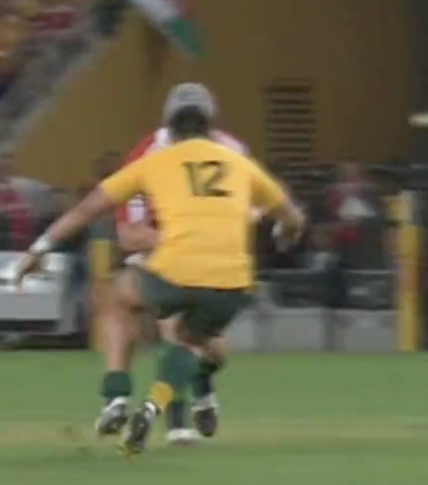
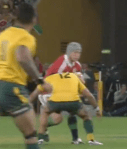
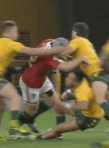
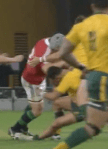
Christian Lealiifano, a physically conditioned 95 kg, started the match at inside centre (usually plays fly-half). From a lineout on the Wallabies 10 metre, the Lions aimed to set up play in the midfield with Jonathan Davies (103 kg) running an almost direct line at the defence. The defender lining up Jonathan Davies, was none other than debutant Christian Lealiifano. Christian Lealiifano was positioned almost directly opposite Jonathan Davies and attempted a front-on tackle. From the match footage, after the contact between the two inside centres, Christian Lealiifano failed to rise to his feet, and showed little or no movement. From the slow motion replay of the attempted tackle, it seemed Lealiifano might have had his head in an unfavorable position, where the vertex (top of his head) was the first point of direct contact with Jonathan Davies causing his neck to flex. From a defense perspective, play was moving from left to right, therefore, it is presumed a standard right shoulder front-on tackle was required.
A couple of points can be made from this unfortunate incident. Firstly, even players at the highest level get it wrong sometimes. Secondly, the importance of head placement and correct technique when executing a tackle. Note, this is not new information. A study conducted by the University of Nottingham, in collaboration with England Rugby Football Union, studied 6219 tackles over 2 English Premiership seasons (2003/2004, 2005/2006) to identify risk factors for tackle injuries 1. In view of this study’s in depth analysis of tackle injury, the attempted tackle by Lealiifano on Davies had all the components to place Lealiifano at high risk of injury. The tackle injury study, published in the British Journal of Sports Medicine (2010), identified the following risk factors for tacklers.
- Playing position – tackler’s playing 10, 12, or 13 have a higher chance of injury than any other position.
- Tackler vs Ball-carrier speed – tackler’s attempting to tackle a ball-carrier with a significantly higher speed before entering have a higher probability of injury.
- Head position before tackle
- Body region struck – tackler’s are at high risk of injury when contacting the ball-carrier with the head or neck.
In addition to these risk factors, Lealiifano was technically playing out of position, which has been reported to also increase risk of injury in the tackle 2. Though, the positional demands of inside centre and fly-half are fairly similar. Also, it was Lealiifano’s debut match, and his first action of the game. Therefore, perhaps with the intention of making a big impact on his debut, he may have been a bit too eager to make the tackle, and as a result, got the timing wrong and found his head misplaced.
The physical and dynamic nature of the tackle contest places players at high risk of injury. While this risk of injury may always be present during these physical contests between the ball-carrier and tackler, techniques to significantly reduce this risk of injury, and at the same time effective from a performance perspective, have been highlighted previously 3. Lets hope Lealiifano is fit and well soon, and the remainder of matches in the British and Irish Lions Series are both injury free, and highly entertaining.
References
1 Fuller CWC, Ashton TT, Brooks JHMJ, et al. Injury risks associated with tackling in rugby union. Br J Sports Med 2010;44:159–67.
2 Garraway WM, Lee AJ, Macleod DA, et al. Factors influencing tackle injuries in rugby union football. Br J Sports Med 1999;33:37–41.
3 Hendricks S, Lambert M. Tackling in rugby: coaching strategies for effective technique and injury prevention. Int J Sports Sci Coach 2010;5:117–36.
by Dr Sharief Hendricks, follow at @Sharief_H
Brad Pitt – poster boy for injury prevention?

Since the popular movie Moneyball (in which Pitt is the protagonist), the use of statistical models to optimise sporting performance has become common place to a variety of sports, including Rugby Union. The successful Leicester Tigers (UK) have been “Moneyballing” for some time: http://www.techweekeurope.co.uk/news/ibm-helps-leicester-tigers-predict-their-game-75406.
Through this statistical model, a team can establish which factors – for example a good night’s sleep or tackles made, are critical to optimal team performance. However, as Dr John Orchard, Australian sports physician to a numerous successful teams, says 1 – there is a vital factor missing from the original Hollywood Moneyball statistical model: player availability. The best player in the world is useless to a team’s performance is he/she is unavailable through injury. And the teams that perform best in a competition have the least injuries – scientific evidence to support this statement is mounting:
- For the 2007 Rugby World Cup campaign, Prof Tim Noakes was asked by coach Jake White to guarantee the availability of his best 22 players in the World Cup final. Prof Noakes was able to provide 21 out of those 22 players – the Springboks won this tournament.
- In AFL, the teams with the most injuries are also at the bottom of the table (http://www.afl.com.au/news/2013-05-21/injuries-take-toll-on-strugglers)
- In the 2008/2009 Qatari soccer (football) season, the best teams had the lowest injury rates 2
So for those coaches and managers who see injury prevention as unnecessary or a waste of time, the message is clear: your team will not perform optimally unless you are considering injury prevention as a vital cog to your team’s performance!
References:
1. Orchard JW. On the value of team medical staff: can the “Moneyball” approach be applied to injuries in professional football? British Journal of Sports Medicine. 2009 Nov 27;43(13):963–5.
2. Eirale C, Tol JL, Farooq A, Smiley F, Chalabi H. Low injury rate strongly correlates with team success in Qatari professional football. British Journal of Sports Medicine. 2012 Sep 15:1–5.
 Rugby Science