Category: Match Statistics
Home ground advantage in #Superugby?
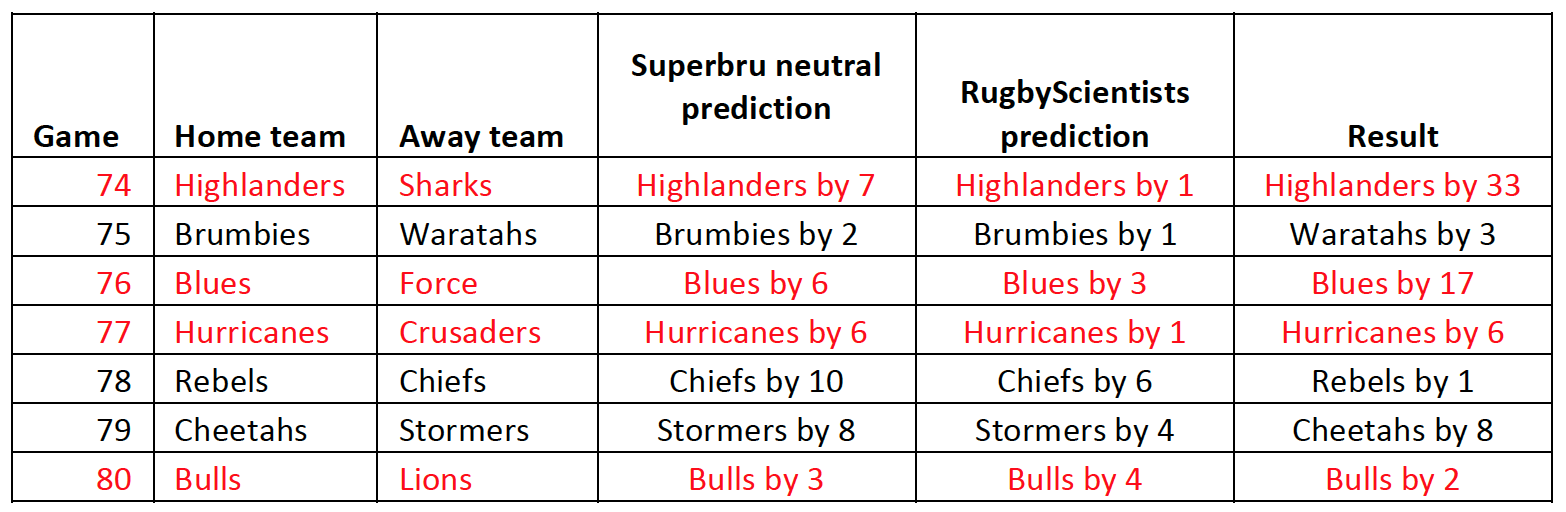
Round 12 saw two unexpected results, with very few picking the Rebels to beat the Chiefs or the Cheetahs to beat the Stormers. Since both the Rebels and Cheetahs were unexpected home-side victories, we looked a bit closer at whether teams playing at home are doing relatively better later on in the competition. The plot below shows, round by round, the proportion of home sides winning. The blue line gives the best fit to the data – it looks like home sides do a little better as the competition progresses. It’s a small effect at best, but worth keeping an eye on. Perhaps playing at home partially offsets the fatigue that sets in later in the competition?

Here are the outcomes for last weekend followed by predictions for the weekend ahead.
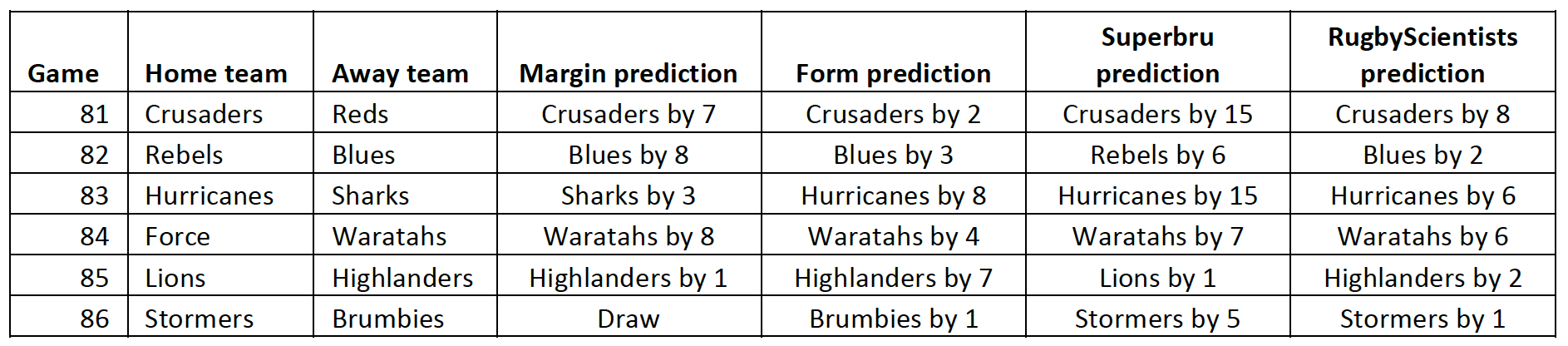
SuperBru predictions Week 8
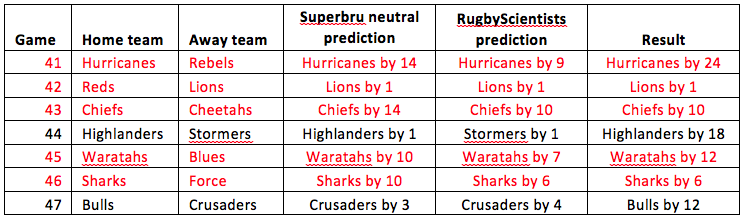
Last weekend’s games went more-or-less according to form: our model got 5 out of 7 correct, but so did the average Superbru user. We ended up moving up the leaderboard slightly though, thanks to no less than 3 exact score predictions! To date our model has outperformed 70% of Superbru users. Here are the details:
This weekend looks like its back to difficult predictions: only the Bulls and Chiefs are unanimously chosen by the three components of our model. Its interesting to note where people expectations are following form (Hurricanes over Stormers, Sharks over Crusaders), where they follow past history (Brumbies over Cheetahs), and where they run contrary to both (Rebels over Reds)!

Ian Durbach
Research in Rugby growing exponentially-Rugby Research’s Top 15
Paging through the recently published book “The Science of Rugby” edited by Dr Craig Twist and Dr Paul Worsfold (link), which covers everything from strength and power training and match-day strategies for enhancing physical and technical performance, to nutrition and biomechanics in both rugby union and rugby league, I remembered there was a time not too long ago published research articles in rugby were few. To check that I was not falling victim to the recall bias, and because it is a Rugby World Cup year, I did a little Scopus search to determine the current status of research in rugby. Scopus is like Google, but for research papers. Scopus also organises information by year, source, country and affiliation.
So, the 1st search I did was for articles using the term “Rugby” in the title, abstract or part of the keywords. Using the term “Rugby” like this in Scopus means both League and Union papers will be included. Note, I did not exclude areas like humanities and business, and all data points may not represent full research articles. This is what we found…
Number of articles published on “Rugby”
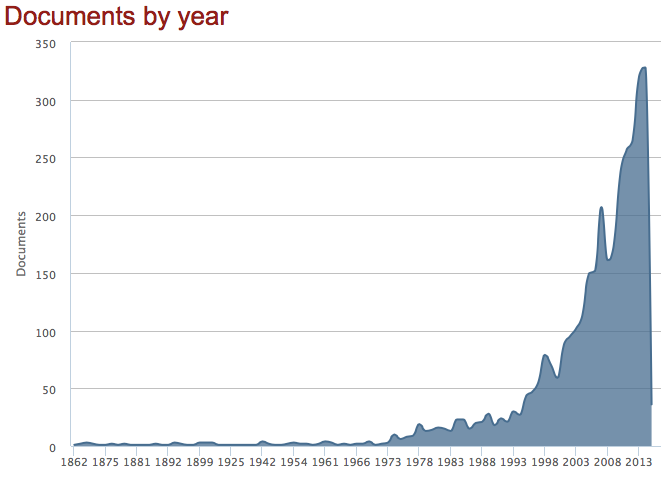
3051 published articles since 1862, 40% of these published in the last 5 years.
Top Journals publishing on “Rugby”
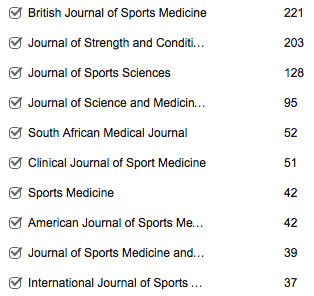
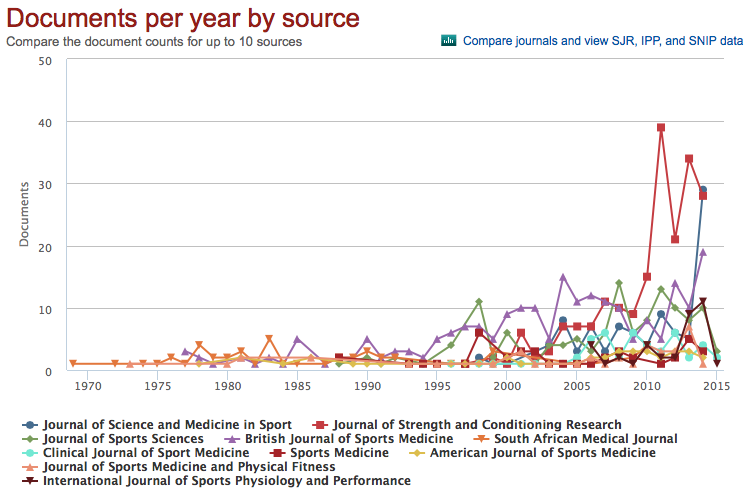
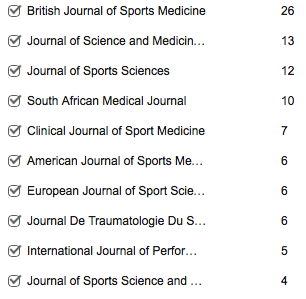
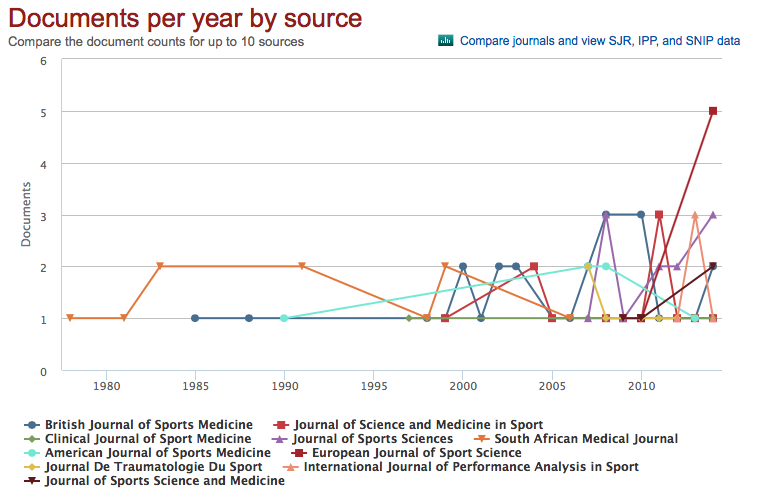
Top journals publishing in rugby are BJSM, JSCS, JSS, and JSMS. SAMJ was the first journal to publish on rugby, BJSM the most consistent, and JSCS the most number of publications in the last 5 years.
Top Authors publishing in “Rugby”
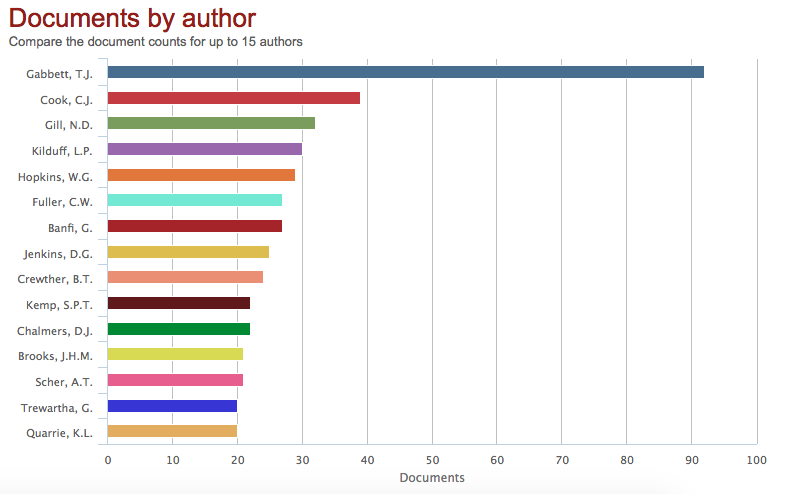
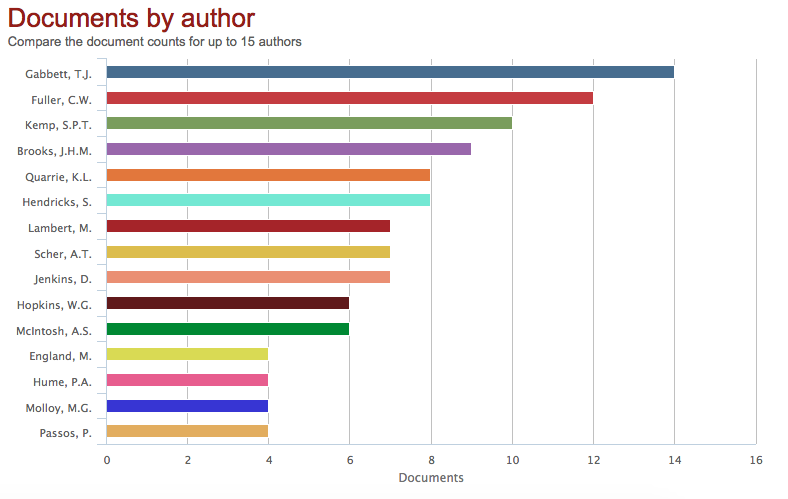
Most published author in rugby- Tim Gabbett (Gabbett Performance)-no surprise there. The head S&C coach of the top performing team in the world, Nicholas Gill, is the 3rd most published author in rugby research. This says something.
Top affiliations publishing in “Rugby”
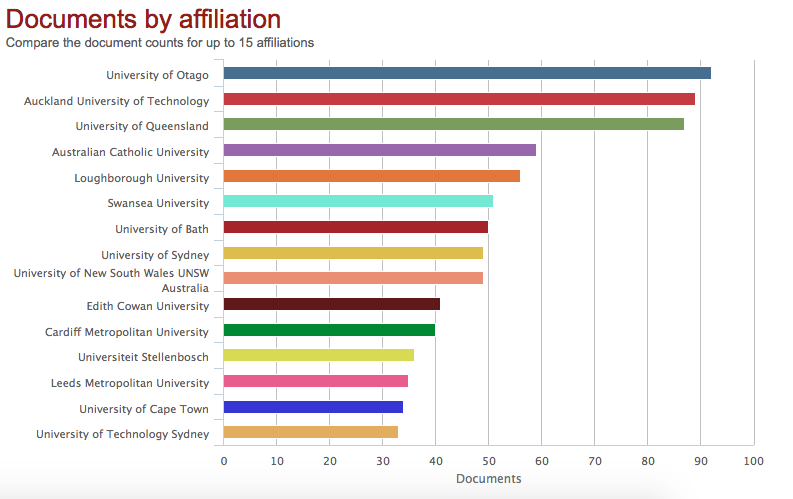
Top countries publishing in “Rugby”
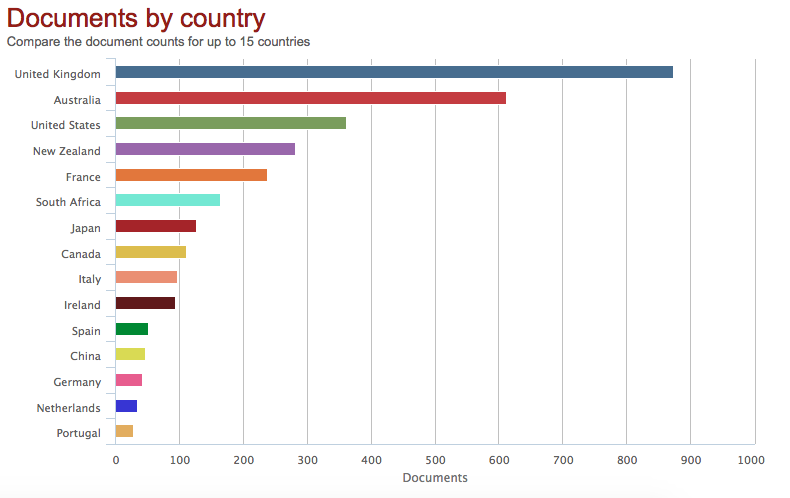
We did the same search for “Rugby Union”. Using this search term will only output papers containing “Rugby Union” in the title, abstract or part of the keywords.
Number of articles published on “Rugby Union”
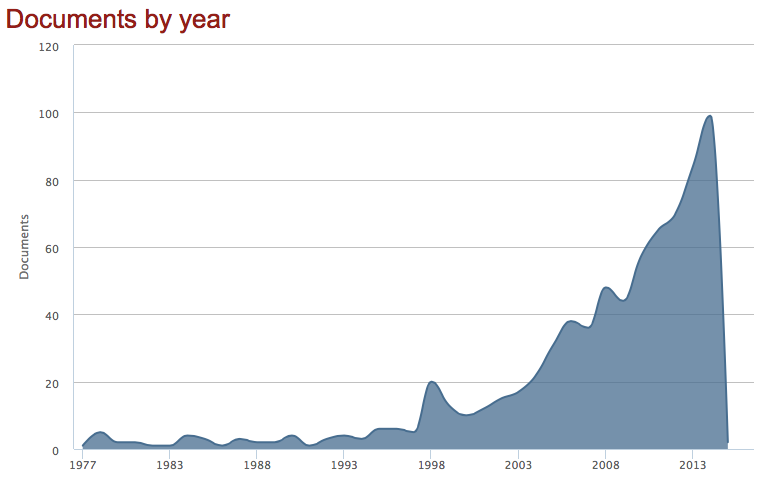
742 articles. Approximately 50% published in the last 5 years.
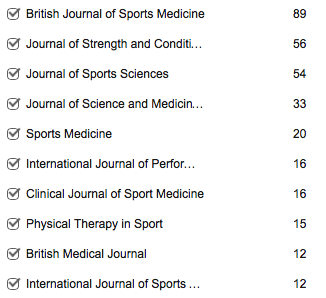
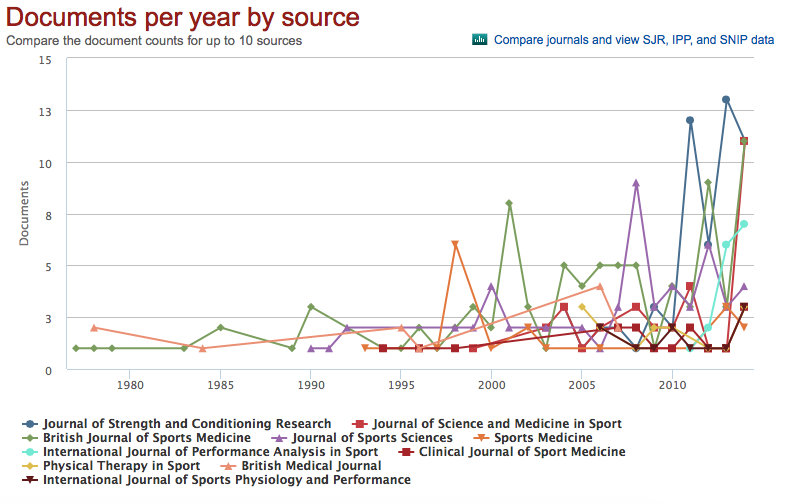
Top Journals publishing on “Rugby Union”
Top Authors publishing in “Rugby Union”
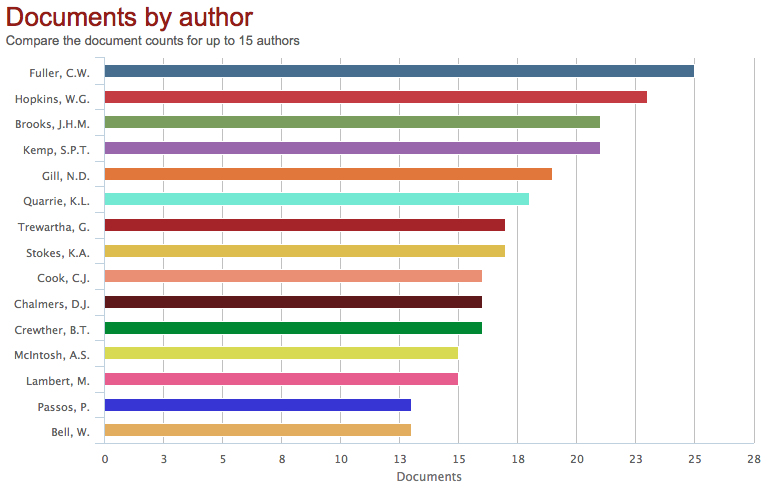
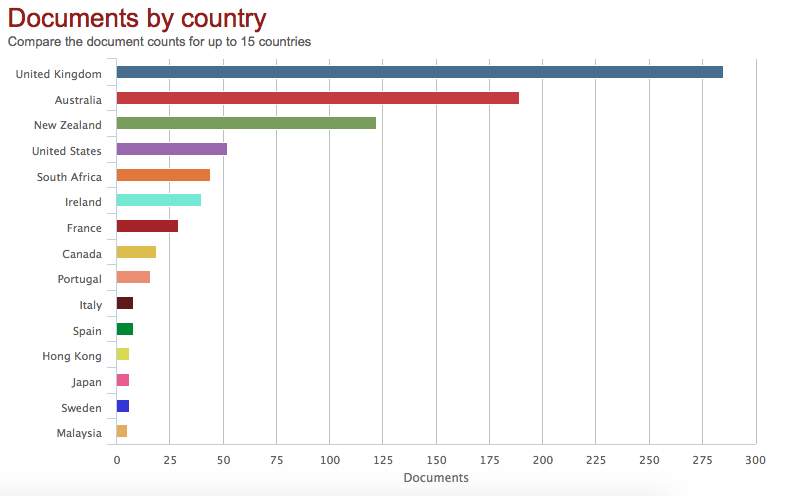
Top affiliations publishing in “Rugby Union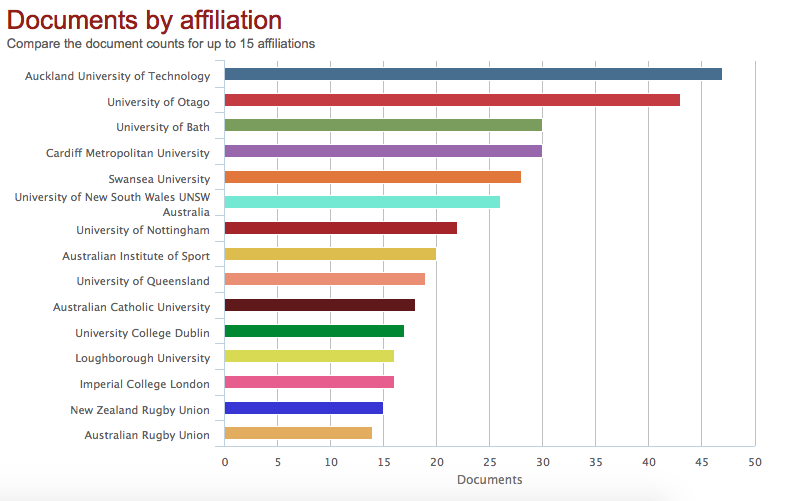 Top countries publishing in “Rugby Union”
I have a particular interest in the tackle situation. So, I did a search for “Rugby” AND “tackle”. Below are the results…
Number of articles published on “Rugby” AND “tackle”
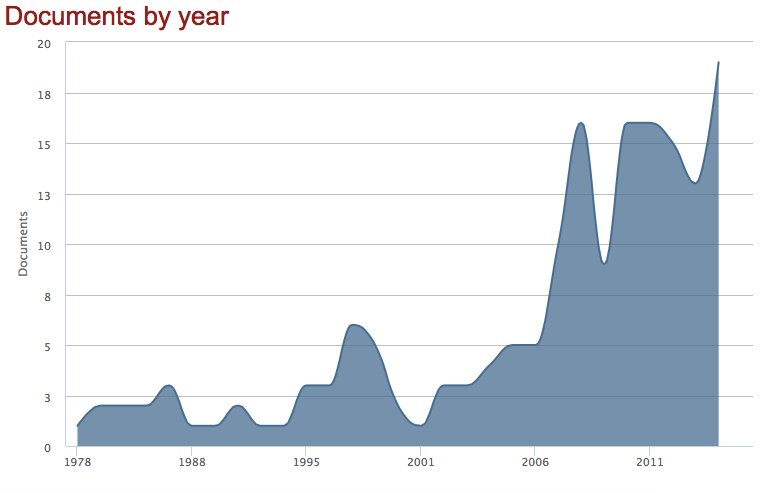 170 articles. Approximately 46% published in the last 5 years.
Top Journals publishing on “Rugby” AND “tackle”
Top authors publishing on “Rugby” AND “tackle”
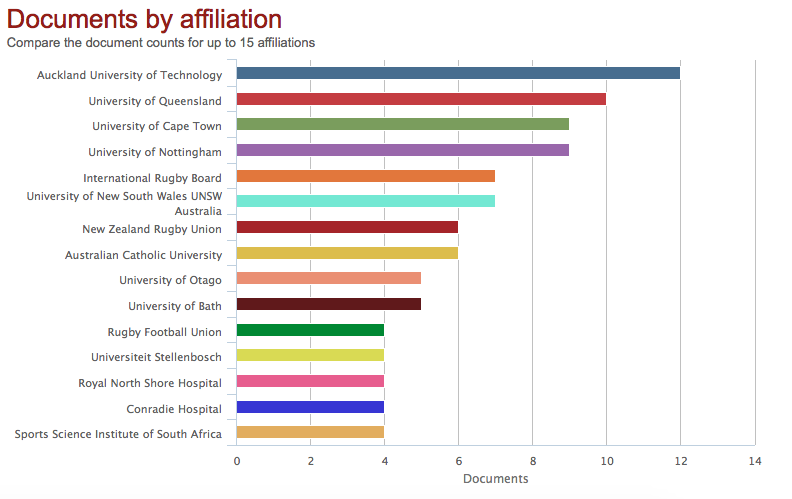
Top affiliations publishing on “Rugby” AND “tackle”
Top countries publishing on “Rugby” AND “tackle”
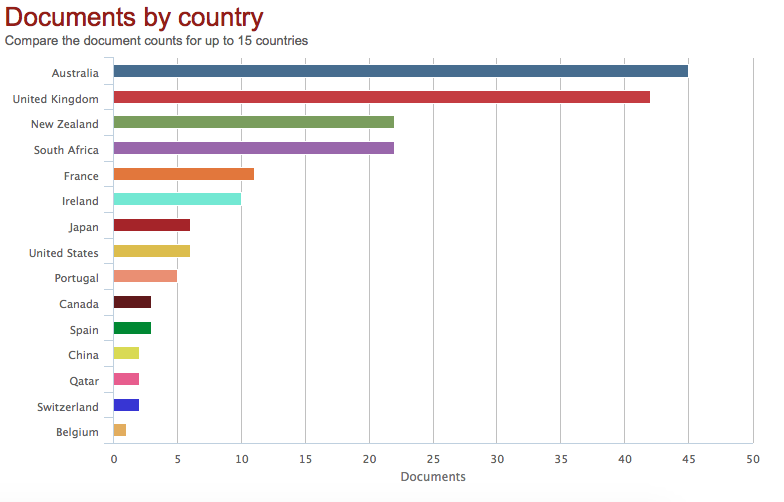
We could do the same searches for any aspect of the sport really (for example, the scrum).
Although research in rugby may be growing at a rapid pace, rugby (league and union combined) is still behind other team sports like football (I did a small search on “football” OR “soccer” and Scopus produced 26941 papers), and there is plenty of scope for research (not too sad about this). There are obvious products from this body of work (better conditioned players, more knowledgeable coaches, reducing the risk of injury, etc), but in terms of conducting research, the exponential increase in rugby research somewhat forces scientists to be creative, and highly applied in their studies.
Sharief Hendricks
 Rugby Science