Category: Strength and Conditioning
Relationship between tackle frequency, injury risk and performance
The tackle is a physical contest between opposing players contending for territory and ball possession. During an 80 minute rugby union match, a player will physically engage in the tackle contest, whether as a ball-carrier or tackler, between 10 to 35 times depending on the position of the player (Deutsch et al., 2007; Quarrie and Hopkins, 2008). During a match, tight forwards (position numbers 1-5, who primarily compete in the set phases such scrums and lineouts) engage in the tackle approximately 10-25 times, loose forwards (position numbers 6-8, who mainly competes for possession of the ball at rucks and assist the tight forwards in set pieces) are involved in 25-35 tackles, inside backs (position numbers 9,10,12,13, whose key responsibility is to execute tactics and distribute the ball) competes in 20-25 tackles, and outside backs (position numbers 11,14,15, who are typically quicker and expected to run into open spaces to cross the advantage line and score points) engage in 10-15 tackles (Deutsch et al., 2007; Quarrie and Hopkins, 2008).

A player requires a high level of skill, physical tolerance and resistance to fatigue to repeatedly engage safely and effectively in the tackle, therefore understanding the physical demands of a tackle is important with many applications such as design and development of proper training drills and equipment, planning and management of training and recovery between training sessions and matches.
The biomechanics of injury risk can be explained by the event either resulting from an overload of the system’s tolerance levels, or a reduction in the system’s tolerance levels through micro trauma to a point where normal loads cannot be tolerated (McIntosh, 2005)
For the tackle, studies have shown a positive relationship between the number of tackles made during matches and markers of muscle damage (Smart et al., 2008; Takarada 2003). Also, repeated tackling decreases the amount of force produced by the tackler, which may be attributed to fatigue (Usman et al., 2011).
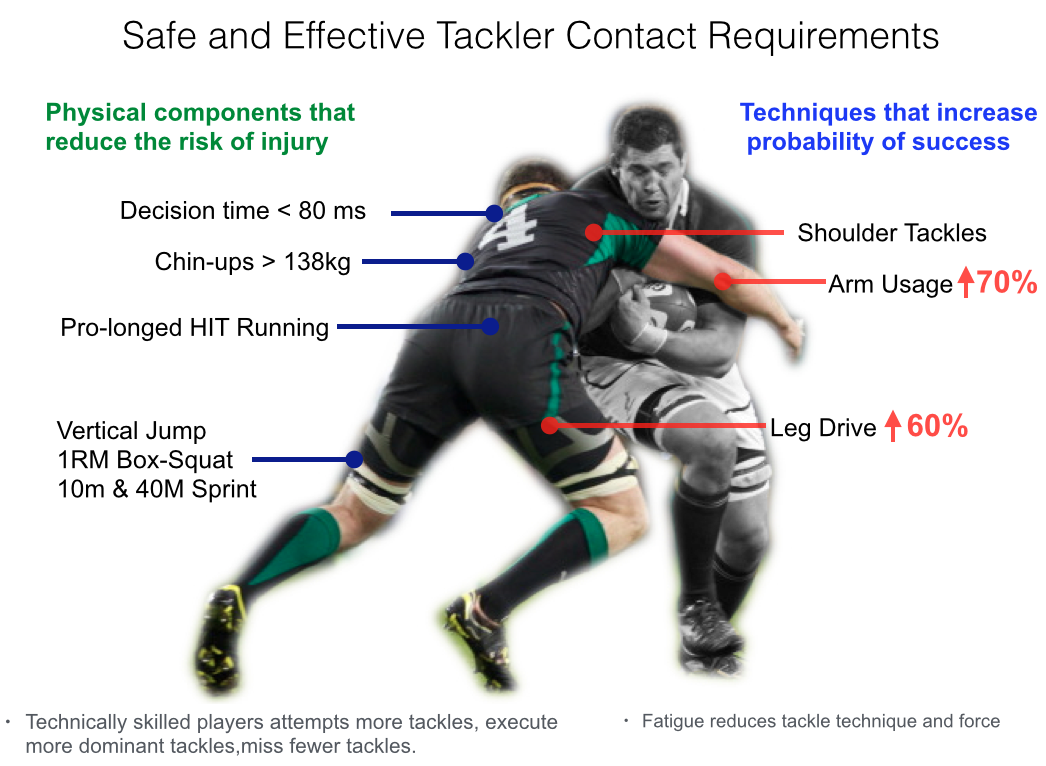
In rugby union and rugby league studies, the specific physical and technical requirements for safe and effective contact in the tackle have been highlight (summary of tackler below).
Based on this, we propose a theoretical model for the relationship between the number of tackles in which a player engages in (acute or chronic fatigue), magnitude of impact (energy load), markers of muscle damage (micro trauma) and how this relationship interacts with tackle injury risk (tolerance overload or reduction) and tackle performance (Hendricks and Lambert, 2014).
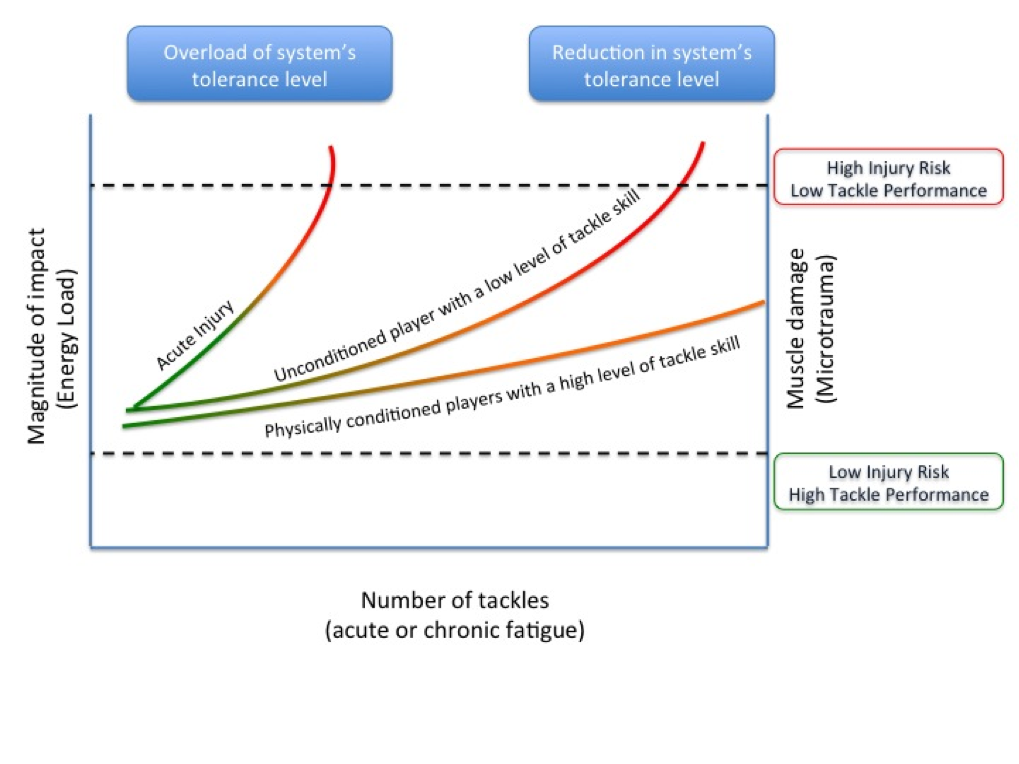 Players may have an upper limit for being able to endure repeated high energy impact tackles. If this upper limit is exceeded the risk of injury is substantially increased, and tackle performance is noticeably decreased (figure below). This upper limit is reached either through one or more very high-energy impact contact situations or, accumulates over a match or season following repetitive lower-energy impact situations. However, effective tackle skill training, proper physical conditioning, strength, power, equipment and attitude/motivation can offset this upper limit (McIntosh, 2005). For example, physically conditioned players with a high level of tackle skill may have the technical ability and physiological capacity to minimise the energy load on the body, thereby increasing their tolerance level for physical loads.
This paper was published in the Journal of Sport Science and Medicine. The full article can be found here http://www.jssm.org/letter.php?id=jssm-13-715.xml .
Sharief Hendricks
Year Round Strength & Conditioning for Rugby Union
Strength and conditioning for Rugby Union should not only be specific to the demands of the overall game but to that of the demands of the respective positions. Further to this exercise selection specific to each training phase needs to be considered when designing a year round strength and conditioning programme for rugby union.
by Wayne Lombard and Rob Arkell

THE FOUR PHASES OF TRAINING PERIODIZATION FOR RUGBY UNION. (THE ABOVE SEASON DATES ARE BASED ON THE SOUTH AFRICAN RUGBY SEASON)
Rugby Union is a sport that incorporates intermittent, short duration, high intensity exercise, maximal efforts of power and strength, muscular endurance, agility and speed. Professional rugby players have been shown to cover up to 6km in a game, spending half their playing time at 78-90% of HRmax. These players also produce maximal sprint velocities lasting 4 – 6 seconds, covering up to 60m at a time. Above all this, players are also exposed to high impact loads, ranging from 6000N – 9000N during a scrum or tackle situation. What makes Rugby even more interesting is that each position requires a very different physiological make up. For example, forwards need to be able to take hits and compete physically for ball possession whereas backs need to be explosive and agile to avoid tackles and take the gaps.
Strength & Conditioning for Rugby
A fundamental principle of training popularized by Verkhoshansky and Siff is the law of “Dynamic correspondence”, which states that “the means and methods of strength training for a specific sport should be chosen to enhance the required motor qualities in terms of,
- amplitude and direction of movement pattern
- Region of force production
- Dynamics of the effort
- Rate and time of force
- Regime of muscular work
Hence, to ensure that the players are optimally conditioned for rugby, it is important that the strength and conditioning programs are specifically designed, not only for rugby as a whole, but also to match the demands of each position. The phases of a strength and conditioning programme should be periodized into four phases (Figure), each with distinctly different training goals and adaptations. The primary goals for strength and conditioning for rugby can be divided up into the following characteristics;
- Muscle Mass
- Muscular Strength & Endurance
- Power
- Aerobic capacity
- Speed & Agility
Conclusion
It is important that training is specific to the demands of rugby to induce the desired physiological adaptations, which are associated with improved performance. Furthermore, it is important that players of all age groups adopt a well structured and designed rugby specific strength and conditioning programme to sufficiently prepare them physically for the demands associated with the game as well as reduce the chance of acquiring musculoskeletal injuries.
References:
Cunniffe, B., Proctor, W., Baker, J. S., & Davies, B. An evaluation of the physiological demands of elite rugby union using global positioning system tracking software. Journal of Strength and Conditioning Research, 23(4), 1195–1203. 2009
Duthie, G., Pyne, D., & Hooper, S. (2003). Applied physiology and game analysis of rugby union. Sports Medicine, 33(13), 973–991. 2003
Lambert, M. I. Aspects of physical conditioning for rugby. (SARU, Ed.) (pp. 1–17). Cape Town : Boksmart. Retrieved from http://www.sarugby.com 2009
Verjhoshansky, Y., Siff, M. Supertraining. 6th Ed. Rome. Ultimate Athlete Concepts, USA. 2009
About the Authors
Wayne Lombard completed his undergraduate and honors degrees at the University of Kwa-Zulu Natal (Durban). He then joined the Sports Science Institute of South Africa as a Biokineticist and Performance enhancement specialist at the High Performance Centre. He then went on to complete is Masters degree and is currently registered for a PhD in exercises science at the University of Cape Town, South Africa. Wayne has worked with various of South Africa’s top athletes in all sporting codes, including some of South Africa’s Paralympic and Olympic athletes.
Robin Arkell completed both his undergraduate and Honours degrees at the University of Stellenbosch, South Africa. He completed his internship at The Sports Science Institute of South Africa, in The High Performance Centre, where he was exposed to a wide range of sporting codes. Robin is currently registered for a Masters degree in Biokinetics at the University of Cape Town (UCT), South Africa, specializing in youth rugby union development. He is also currently the Strength and Conditioning coach for the UCT 1st XV rugby union team.
 Rugby Science