Experts vs Data: on the science of predicting SuperRugby performances

With SuperRugby beginning again this weekend, we’ve managed to get a true scientist, Dr Ian Durbach, to comment on the ability to predict outcomes. Ian holds joint positions as adjunct senior lecturer in the Department of Statistical Sciences at the University of Cape Town and a researcher at the African Institute for Mathematical Sciences. His research interests are human judgment and decision making, particularly the way we reason when our choices involve risk or uncertainty. Quite simply, he’s a really clever guy.

When we asked Ian if we could apply science to predicting game outcomes so that we could be consistently correct as rugby experts such as Nick Mallett, he came up with a plan. Ian explains in his own words:

Screen Shot 2015-02-12 at 2.11.30 PM

Picture from supersport.com “Dont miss out, warns Mallett”

The model we’re using is cobbled together from a variety of sources, and uses a few relationships we’ve been able to establish by looking at past performance and past predictions.

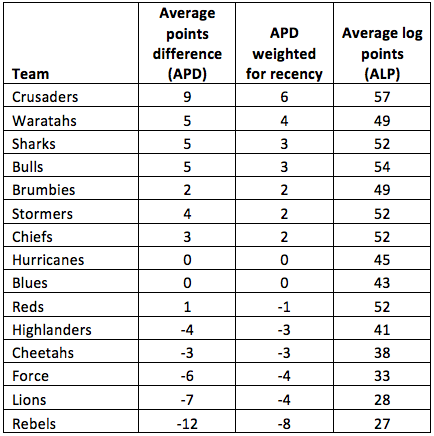
First, we looked at past 4 years of Super 15 rugby and worked out how many points each team won or lost by, on average over all the games they’ve played. The Crusaders come top – they have an average margin of +9, meaning they win by an average of 9 points. The table below shows the ranking, along with the average log points – you can see there’s a good but not perfect relationship between point margins and log points.

In our model, we’ve chosen to weight recent years more heavily, which also has the effect of sucking the values of all our predictions towards 0. Those values are in the third column of the table. This is actually a desirable feature to have whenever we know that the past is not a perfect predictor of the future – we’ll spare you the details!
Screen Shot 2015-02-12 at 2.19.32 PM

Average points differences can be used to come up with a quick and dirty prediction. Take this weekend’s game between the Crusaders and the Rebels. We know the Crusaders win by 6 points on average. When they play the bottom teams they’ll tend to win by more, and when they play other top teams they’ll tend to win by less. The Rebels lose by 8 points on average. When they play a top team like the Crusaders, they’ll tend to lose by more than this. You can get a crude prediction by subtracting the two points differences from one another: the Crusaders are predicted to win by 6–(–8) = 14 points. That’s a start.

Next, we found that over a number of years, playing at home is “worth” about 4 points. That is, if you knew nothing at all about an upcoming game, you should predict the home team to win by 4 points. We know the Crusaders are playing at home, so we up the prediction in their favour, by 4 points. They’re now predicted to win by 18.

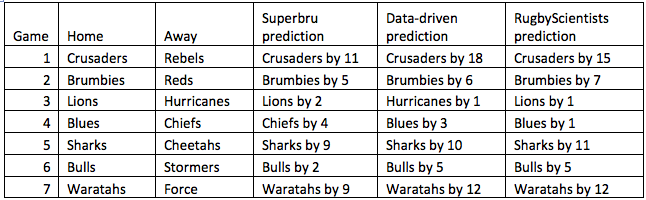
This is a data-driven prediction. But we know that rugby pundits are pretty good at predicting games. We’ve looked at some past predictions made by 80 000 users of the Superbru game. The players predicted the outcome of 73% of Super 15 games correctly, and were on average 10 points from the actual outcome of the game. Not bad! We found the following Superbru predictions for the upcoming week, which we’ve contrasted with the predictions from our data-driven approach. On the whole its amazing how similar the predictions are. We predict different outcomes for the Lions-Hurricanes and Blues-Chiefs games, but both sets of predictions are for the games to be close.

Screen Shot 2015-02-12 at 2.20.10 PM

An obvious weakness of the data-driven approach is that it ignores a whole bunch of relevant current information – off-season transfers, injuries, form, and so on. Some of this we’ll work on building into later predictions, but for now we can assume that Superbru users are clued up on current rugby events, and use their predictions as proxies for that information. So we’ll make an additional prediction, which is a combination of our naïve data-driven model and the Superbru predictions.

Before we do that, an interesting fact is that Superbru users tend, on average, to slightly underestimate the effect of playing at home. They think it is worth around 2 points, while we know that it is actually worth about 4 points. So, if we know Superbru users think about a game, we should adjust their predictions by 2 points in favour of the home team before combining them. For now we’ll combine them in the simplest possible way, but taking the average of the two.

That’s all we’re going to do for now. Once we start getting some information in on how the teams are performing, we’ll use this information to adjust our model further. Let’s see how we do!
Screen Shot 2015-02-12 at 2.20.17 PM

Mallet seems to think Chiefs will win when he referred to the team being “good again”. Who do you think will be proved correct? The experts (rugby and Superbru/couch) or the scientists?  We’d like to know your thoughts before the Blues vs Chiefs match kicks off. Tell us in the poll or feel free to comment!
Contact Skills, Ecological Validity & Representative Design

Dynamical systems theory proposes that team sport is a complex system, with many independent, but interacting components that vary over space and time. Here, skill learning and execution are the functionality of the player-environment, where the constantly changing environment affords the player(s) opportunities to act. It is ultimately the ability of the player to interact and adapt with the changing environment (this includes teammates, and opposition players) and the constraints of the task to achieve its purpose (for example, beating the attacker). Based on this theory, the task and environmental constraints of training or testing should provide valid perceptual cues and be representative of the conditions in a competitive match environment.

Photo by Peter Heeger / Gallo Images

Photo by Peter Heeger / Gallo Images

Ecological validity refers to the empirical relationship between a cue (i.e. perceptual variable) or a series of imperfect cues to infer or predict future actions towards achieving a goal. In other words, this is the way in which skilled players use available information or cues from their opponents and environment to predict future actions before their own movements are initiated.

Representative design refers to the arrangement of conditions and constraints of an experimental, learning, or testing environment so that the conditions or constraints represent the performance environment to which the results are intended to apply.

Skills and actions executed in a testing or training environment should be able to easily transfer to the performance environment (known as action fidelity).

Both ecological validity and representative design exist on a (distinct) continuous scale, and not in absolute terms . If full teams competing against each other are considered the complete system, sub-systems at different levels of interaction between teammates, opponents and the immediate task exist. The simplest of these subsystems is the interaction between an attacker and defender. From an ecological validity and representative design point of view, 1 vs 1 attacker and defender interactions are also the easiest to study. Building on from the 1 vs 1, to 3 vs 3, 5 vs 5 and so on, the interactions between teammates and opposing players become more complex, and perhaps harder to study from an ecological validity and representative design perspective. Furthermore, as one progress through the sub-phases, from 1 vs 1, to team vs team interactions, players’ behaviours become more stable and predictable as decisions may also be pre-planned based on team goals (i.e team tactics and strategy) and not the environment alone. This is not to say that player’s will not adapt to their immediate environment and act accordingly.

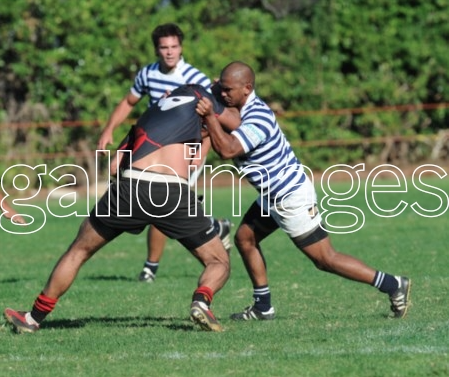
Player well-being during a training and testing is of utmost importance. Needless to say, that a skill training or testing should present a player with minimal risk of injury. Rugby is a full contact sport, with higher risk of injury compared to many other team sports . During a match, the correct execution of contact skills allows players to tolerate frequent high impact physical contact situations like the tackle.

Keeping ecological validity and representative design in mind, it should be noted that coaches and players are reluctant to engage in full, match-like contact for training or testing because of the risk of injury. With that said, contact skills are an essential part of safe participation and performance in Rugby, and therefore cannot be neglected.

Even though Dynamic Systems theory predicates that during competition a player’s movements are emergent and variable based on the affordances of the environment, it acknowledges the existence of an approximate movement pattern, which is stable and reproducible on separate occasions, but able to vary and adapt according to the situation. This notion is particularly important for contact skills, as failure to execute certain technical actions in contact increases the risk of injury and reduces the probability of success. In other words, controlled conditions with a focus on contact technique for contact skills will benefit both the advanced and developing player.

References

Pinder, R.A., Davids, K.W., Renshaw, I., and Araújo, D., Representative Learning Design and Functionality of Research and Practice in Sport, Journal of Sport and Exercise Psychology, 2011, 33(1), 146–155.

Araujo, D., Davids, K., and Passos, P., Ecological Validity, Representative Design, and Correspondence Between Experimental Task Constraints and Behavioral Setting: Comment on Rogers, Kadar, and Costall, Ecological Psychology, 2007, 19, 69-78.

Passos, P., Araújo, D., Davids, K., and Shuttleworth, R., Manipulating Constraints to Train Decision Making in Rugby Union, International Journal of Sports Science and Coaching, 2008, 3(1), 125–140.

Hendricks, S., and Lambert, M., Tackling in Rugby: Coaching Strategies for Effective Technique and Injury Prevention, International Journal of Sports Science and Coaching, 2010, 5(1), 117–136.

Hendricks, S., Lambert, M., Masimla, H., and Durandt J., Measuring Skill in Rugby Union and Rugby League as part of the Standard Team Testing Battery, International Journal of Sports Science and Coaching, 2015. In press.

Thoughts?

Sharief Hendricks


An Overview of Energy Systems

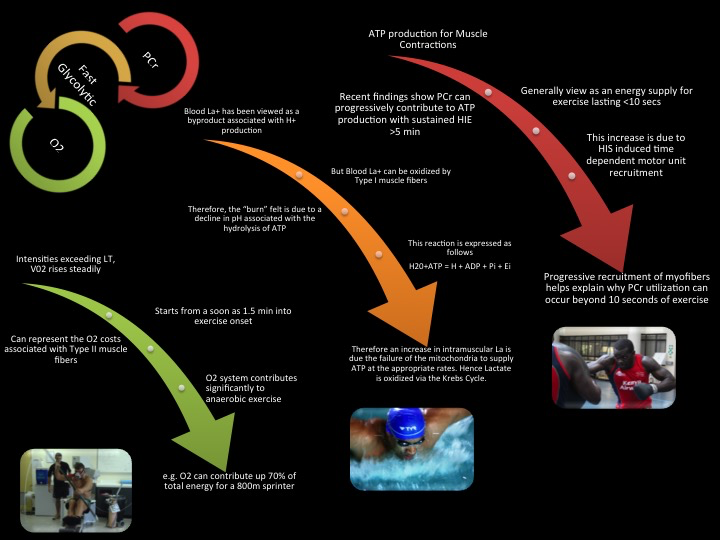
As a follow up to our last post on LSD vs Interval training, here is an overview of how each energy system works and the relative time frame for the onset of each. However, it is important to remember that at all time all energy systems are working, only that one is more dominant that then other at specific times and intensities. This would hopefully give you a clear understand of how to structure your energy system specific conditioning for different sporting needs.

Slide1

Wayne Lombard