Which teams are the biggest #Superugby “predators”?

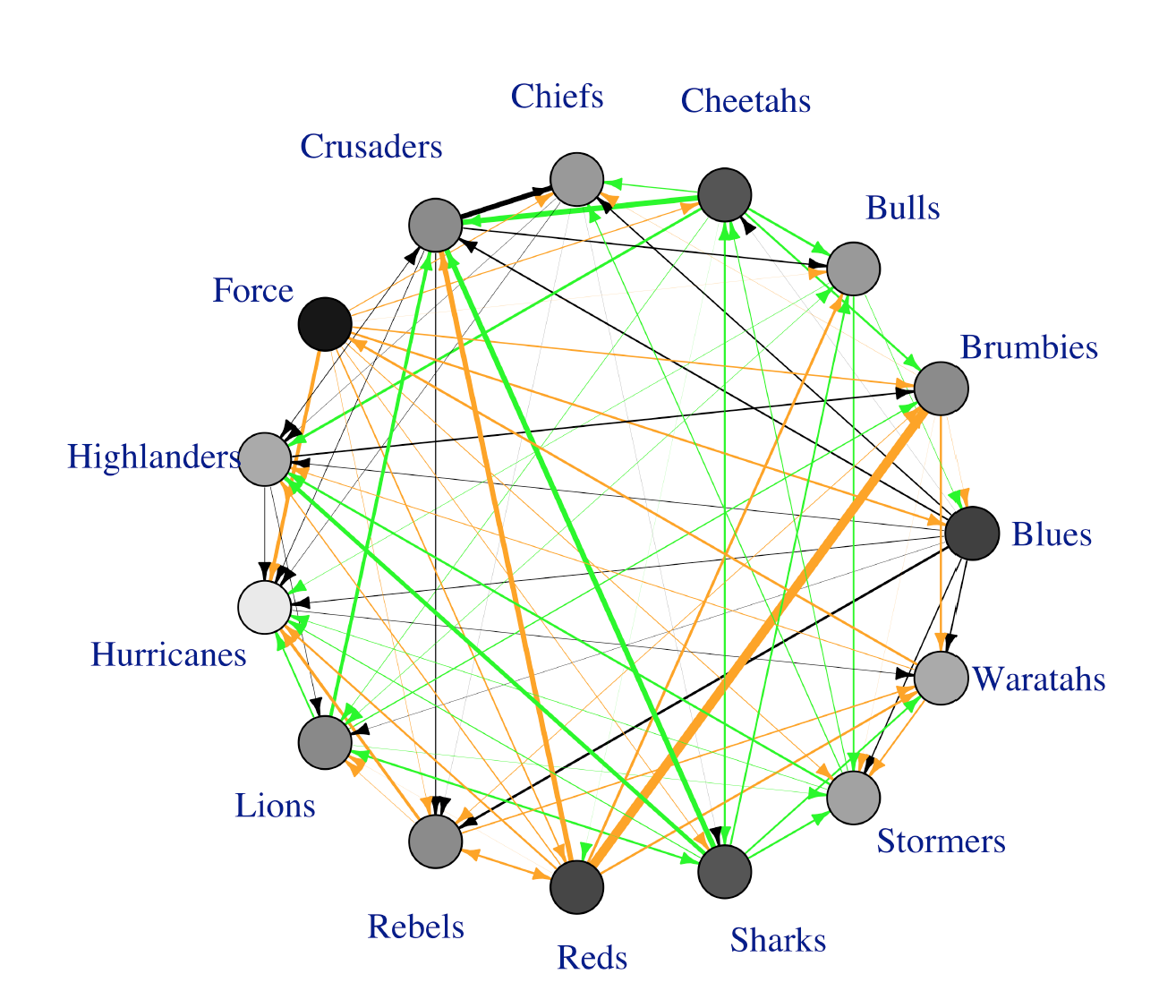
With the league phase of the competition drawing to a close, we ask the obvious question: what would this year’s Super 15 competition look like as network of predator-prey relationships? The plot below summarizes the competition so far. Arrows represent the flow of points, so the arrows point from losers, the “prey”, to winners, the “predators”. The top teams, like the Hurricanes and Highlanders, will have more arrows pointing in to them. The thickness of the lines tells you the size of the victories. The Brumbies have been feasting on the Reds, for example. The colours show what country the loser came from. The Stormers, for example, have many wins but these are mostly against local opposition. Finally the circle representing each team is shaded according to points differentials, with lighter colours indicating a better points difference. The Force’s colour is the same as their fortune this year, dark. A picture tells a thousand words!

Screen Shot 2015-05-22 at 9.37.58 AM

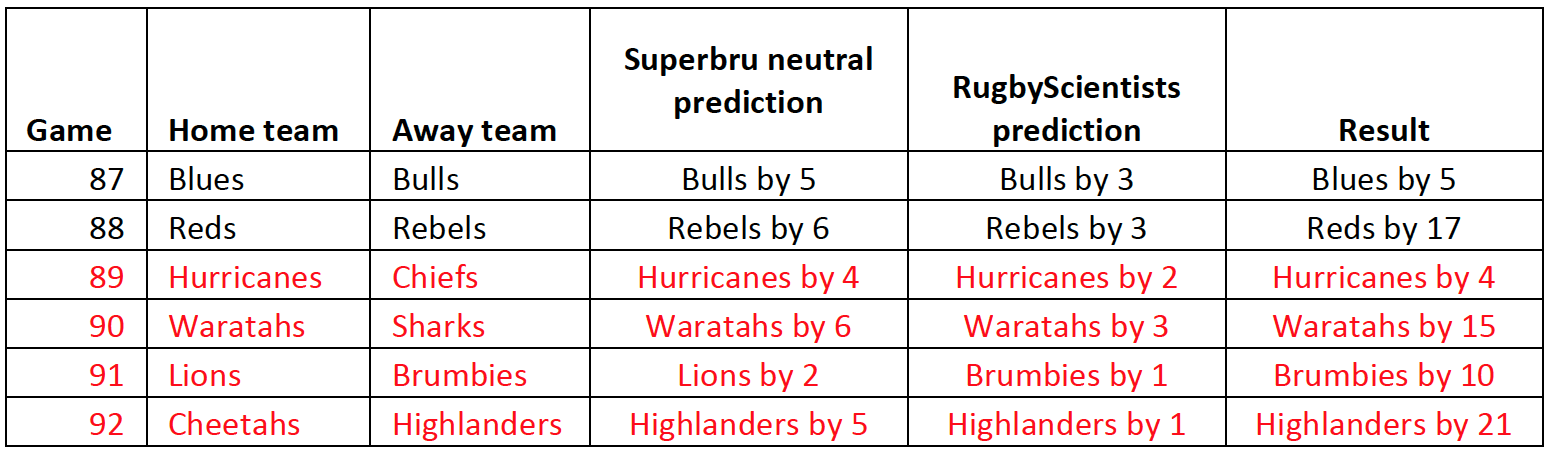
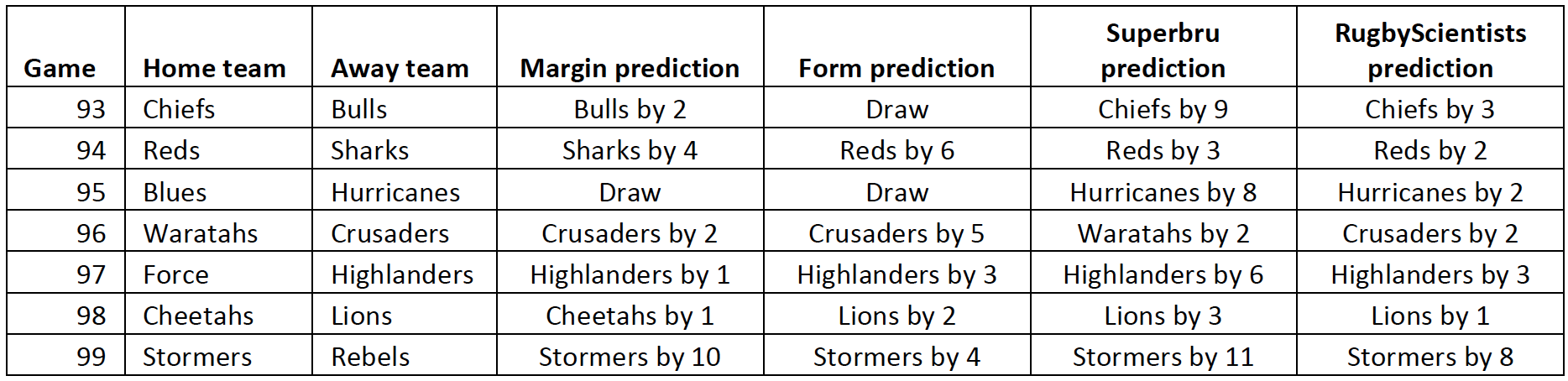
Here are the outcomes for last weekend followed by predictions for the weekend ahead.

Screen Shot 2015-05-22 at 9.38.11 AM

Screen Shot 2015-05-22 at 9.38.20 AM

“Open Your Eyes Ref!!” The Impossible Visual Task of Refereeing

This week’s article is a contribution from Grant Van Velden. 

Grant van Velden is a High Performance Sport Scientist at the Centre for Human Performance Sciences at Stellenbosch University. He has a keen interest in the influence of sports vision and decision making training on the performance of athletes. He has worked with Australian rugby stars James O’Connor and Quade Cooper, Springbok’s Juan de Jongh, Gio Aplon, Elton Jantjies, Morne Steyn & Pat Lambie, the Springbok Sevens team, the SA Rugby Referees Association, the Maties Rugby Referees Academy, Varsity Cup and Young Guns teams. Follow Grant on Twitter: @gvanvelden

Blind mouse

Over the duration of this year’s Super 15, there has been much debate as to the standard of refereeing, let alone this past weekend’s refereeing and TMO performance during the Sharks game. It seemed that elite referees were making some shocking on-field calls that ultimately changed the outcome of a few games. In a World Cup year, this should be the last thing that the rugby public, coaches, and players should be concerned about. Now every rugby supporter is very quick to jump on the “Give the whistle a ref” band wagon when their team is performing poorly and calls just don’t seem to be going the way of their team – I too was one of these frustrated supporters until I began working with a Rugby Referees Academy here in Stellenbosch where I realised that referees actually have it in for them before they even step onto the field.

Let’s take a ruck for example, which is an area of the game which is highly debatable and interpreted differently by different referees of different nations. The amount of law infringements that can possibly be made at a ruck is immense, from players entering the ruck from the side, to not releasing the tackled player on the ground, to holding the ball on the ground, to defenders not staying behind the last mans feet; the list can go on and on. All the time that the ruck is occurring, there is an attacking backline setting up to try and pierce the wall of defenders who are also setting up to try and counter their opponents attack by putting in some bone crunching hits. When the ball finally emerges from the ruck, the referee needs to make sure that the defending backline is not offside while at the same time monitoring whether the attacking backline does not throw any forward passes. He also needs to monitor any foul play such as high or spear tackles by the defending team, all while trying to avoid interrupting play by getting in the way of players but still being able to move into the best possible position to “see” what is happening in front of him. This would all change if the scrumhalf puts in a box kick from the ruck instead of passing it to his flyhalf, where a whole new set of infringements can occur such as attacking players been in front of the kicker, pillar players blocking the defenders access to the kicking scrumhalf; once again the list goes on and on.

From a vision perspective, this is an almost impossible task for one referee to do on his own due to the amount of visual focus areas that the referee is required to focus on during a game. A referee simply cannot give 100% focus to one area without another area suffering – put into a rugby situation; a hooker will not be able to throw straight into the lineout if he also needs to focus on whether his teams flyhalf is standing flat, deep, wide or narrow. And that is asking the hooker to only focus on one other situation on the field and not many other situations as in the case of the referee!!

In my opinion it makes sense that rugby evolves into having more than one referee on the field of play in order to lessen the vision and decision making load that is currently placed onto referees. Referees can then give more focus to specific areas of play if they know that there is another referee on the field who is monitoring the other areas of play that has been assigned to them. One referee may be assigned to monitor the lineout while the other referee monitors the attacking and defensive backlines. A referee on either side of the scrum to monitor binding or early engagements would certainly help to make the scrum contest more even. Many team sports in other disciplines have a number of referees on the field of play during a game – American Football has seven referees, field hockey has two umpires, Aussie Rules has nine umpires. With the game getting faster and faster and the hits becoming bigger and bigger, surely it is time to look at bringing more referees onto the playing field in order to make sure the game is played fairly by both teams? Stellenbosch University has been using a two referee system (two referees officiating on the field of play, as well as two assistant referees) in their Koshuis Leagues for many years now with great success; the Varsity Cup has successfully trialled the two referee system for the last few tournaments with outstanding success. So maybe it is time to look at such a system and trial it a higher level such as at the Currie Cup.

So my closing thoughts are this: Isn’t it time that rugby moves into an era where having more on-field referees is the norm? Isn’t it time that the skill and precision of the players on the field determines the outcome of a game and not the referee?

Decision making in elite rugby – what separates the best from the rest

This week’s post was sent to us by Navitas on behalf of the authors Mr David Johnston and Dr Ben Morrison of the Austrailian College of Applied Physiology (ACAP). “ACAP is a subsidiary of global education provider Navitas Limited. Navitas is a proud sponsor of the Australian rugby team, Western Force.” Read more about the authors and their institutions at the end of this post:

New research sheds light on decision making of elite rugby players

New insights coming out of the Australian College of Applied Psychology (ACAP) have taken researchers a step closer to understanding what separates superior athletes from novice players, by analysing players’ decision making during rugby league games.

Masters student David Johnston conducted and led the research into rugby players of various skill levels to identify key factors which emerge in the development of expertise. It involved careful and intricate construction of game situation ‘scenarios’ to enable the players to demonstrate their processes of decision making.

Previous research suggests that cue use (i.e., the ability to recognise key indicators during decision making) is a significant factor in sport-related performance. Mr Johnston’s research indicated that higher skilled players demonstrated greater cue discrimination, assigned different meaning to the cues, and processed cues in a different manner to lower skilled players.

“This research demonstrates the close relationships that can be formed between the scientific investigation of skilled performance and the practicalities of training in high level sports. The further development of this work would allow training of novice players to be targeted toward the acquisition of high level skills in an efficient manner,” Mr Johnston said.

Ten rugby league playmakers – six of whom played with a professional rugby league team and four from amateur clubs – were interviewed using a Cognitive Task Analysis (CTA) technique in the research.

A CTA is an interview method that involves the recall of a non-routine event to explore the decision-maker’s unique response to the event. These methods are designed to elicit information about the cues, goals and strategies used by the players.

The work was supervised by Dr Ben Morrison, a lecturer in the School of Psychological Sciences, who has extensive experience in the study of decision making in natural settings.

“This research is really exciting because it has opened the door to further research which could help us understand the evolution of cue use across expertise, and whether we can model expert cue use in training programs for less experienced players,” he said.

Mr Johnston will present his research into rugby player decision making at the prestigious International Conference on Naturalistic Decision Making in America in June. He is presently studying for his Master of Psychology (Clinical) degree in the School of Psychological Sciences at ACAP. He is also the winner of the 2014 Australian Psychological Society Prize for the best honours student, for which will be awarded at the ACAP Sydney graduation ceremony in May.

For further information, please contact:

Dr Ben Morrison

PhD, B.Psych (Hons), MAPS

Lecturer of Psychological Sciences

Course Coordinator for Bachelor and Graduate Diploma of Psychological Science

Australian College of Applied Psychology

Tel: +61 (02) 9964 6373

Email: Ben.Morrison@acap.edu.au

Imogen Clark

Corporate Affairs Coordinator

Navitas Limited

Tel: +61 (08) 9364 0021

Mob: 0498 574 633

Email: Imogen.Clark@navitas.com

About Australian College of Applied Psychology

The Australian College of Applied Psychology (ACAP) has been a leader in applied psychology education for over 30 years. ACAP offers specialist courses in counselling, psychology, coaching, social science, social work, youth work and case management and has over 5,500 students studying on-campus or online. ACAP is a nationally registered training organisation and a register higher education provider. Further details about ACAP are available at www.acap.edu.au

About Navitas

Navitas is a leading global education provider that offers an extensive range of educational services through three major Divisions to students and professionals including university programs, creative media education, professional education, English language training and settlement services. Navitas is an S&P/ASX100 company. Further details about Navitas are available at www.navitas.com